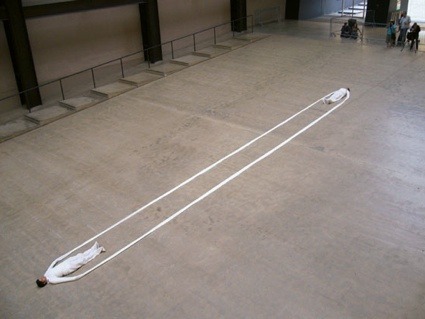
No Robots from YungHan Chang
Categories
No Robots from YungHan Chang
Encounter(s), Tejal Shah X Varsha Nair.
Straitjackets: The work amplifies the paradox of our highly networked reality wherein technology variously connects, only to ironically distance us.
There’s no real brick-and-mortar analog for what they are building, and no quantifiable data set to determine the objects they pick. They simply look for beauty and color and style.
They drive the selection based more on emotion than data. They refused to make any decisions around what sold well for the first three months of the business, trusting their guts that if they love what they’re selecting, shoppers– or “readers”– will too. That isn’t an etailer. That’s Anna Wintour. “We needed to just let it develop,” says Goldberg. “We wanted people to look forward to opening the email and reading the site, no matter what they bought.”
Added Shellhammer, “We do what a good editor does. We take stuff and put it together in a way that creates something new.” They’re selling a lifestyle that cuts across categories.
The difference was pronounced in a recent meeting Goldberg had with a Valley-based recruit for a technical position. Within in ten minutes of the interview the two were fighting. Goldberg asked what he’d do with the Fab homepage, and the recruit gave the usual spiel about A/B testing the layout to see which products made people click more, and how the data said they should be laid out on the page. He called the product placements on the front page “ads,” and Goldberg balked. They aren’t ads, he said, they’re editorial. “We aren’t trying to make people buy certain things, we want to guide them through a story,” he says.
The approach is clearly resonating.
Because hunting, gathering and discovering rewards my eager, inner child. Wonder and delight. Intense curiosity, fulfilled for the moment. For the same reason that guided tours of new cities never appear on my to-do list. Happy to put in the work, and read about a place. But prefer to walk and wander. Open to serendipity. And happy accidents.
Good designers aim to move beyond what you get from simply asking consumers what they need and want.
First of all because they understand that most people when asked don’t say what they mean or mean what they say, but also because people often don’t know.
Good designers want to unearth what consumers can’t tell them: latent & emerging needs and motivations; actual behaviors and attitudes; and, crucially, barriers to as well as drivers of change — or simply put, what your competitors don’t also already know.
When good designers talk about innovation, they mean ‘the successful exploitation of new ideas.’ They don’t stop with the invention. They turn their inspirations into reality.
… the key to a future of Abundance is the ability of technology to generate exponential growth, rather than linear growth.
Linear growth is what gives you something like Angry Birds for Facebook.
Exponential growth is what gives you a radically new technology platform capable of changing the world. In a world now measured in terms of billions of potential consumers, iterating 30 times (2^30) with an exponential technology takes you to that magic one billion mark. As a proponent of the coming Singularity, Diamandis understands how exponential change in one field – such as computing – can lead to exponential change in fields ranging from energy to biotechnology to artificial intelligence.
People who are really serious about software should make their own hardware.

 Wandering Wandering Star