The real shortage we face is dreams, and the wherewithal and the will to make them come true.
Categories
The real shortage we face is dreams, and the wherewithal and the will to make them come true.
A timely reminder from past revelations and insights. And by ‘past’, I mean, the umpteenth re-reading of the book (hardcover w/ paper).
CPUs for the meeting, reflected in the window of a Soho specialist in mod paraphernalia, are a fresh Fruit T-shirt, her black Buzz Rickson’s MA-1, anonymous black skirt from a Tulsa thrift, the black leggings she’d worn for Pilates, black Harajuku schoolgirl shoes. Her purse-analog is an envelope of black East German laminate, purchased on eBay if not actual Stasi-issue then well in the ballpark.
She sees her own gray eyes, pale in the glass, and beyond them Ben Sherman shirts and fishtail parkas, cufflinks in the form of the RAF roundel that marked the wings of Spitfires.
CPUs. Cayce Pollard Units. That’s what Damien calls the clothing she wears. CPUs are either black, white, or gray, and ideally seem to have come into this world without human intervention.
What people take for relentless minimalism is a side effect of too much exposure to the reactor-cores of fashion. This has resulted in a remorseless paring-down of what she can and will wear. She is, literally, allergic to fashion. She can only tolerate things that could have been worn, to a general lack of comment, during any year between 1945 and 2000. She’s a design-free zone, a one-woman school of anti whose very austerity periodically threatens to spawn its own cult.
“Our work is often described as creepy. But we make things that are so… clickable.”
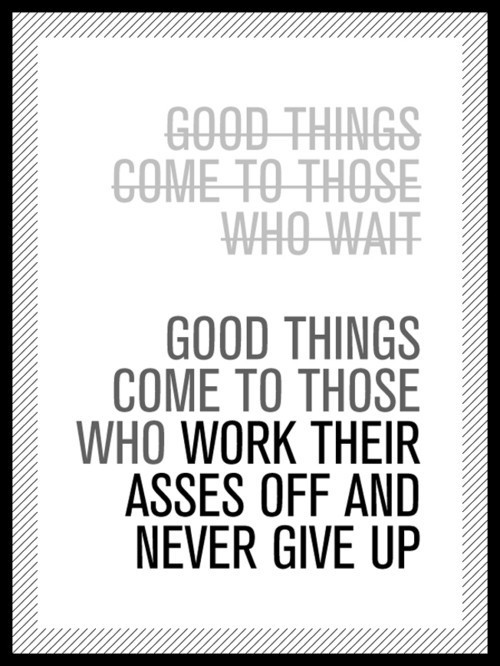
There’s a big difference between designing for ‘metrics of success’ vs. designing to solve a customer’s problem (that they may not know is a problem, yet).
…there’s a balance to be struck between obsessively knowing your stuff and simply enjoying where it’s going.
“There’s plenty of kids now who don’t have a clue about that, who all think it started with the Caspa & Rusko FabricLive CD. And fair enough, they don’t need to know about all that stuff,” he said when asked whether he was fed up of talking about dubstep’s founding myth. “It’s like, if a kid doesn’t know all their history, some geek on a forum will be like, ‘You’re not true to the sound.’ But why do they need to care about it?
It’s a bit like someone just turning 17 or 18 now and going out to their first techno night, and someone going, ‘Oh what, you don’t know who Jeff Mills is?’ You kind of just know it or you don’t.”
The perils of “advice autopilot”
Advice autopilot is when you’re too lazy to think originally about a problem, instead regurgitate whatever smart thing you read on Quora or Hacker News.
If you’re a bit more connected, instead you might parrot back what’s being spoken at during Silicon Valley events and boardrooms, yet the activity is still the same – everyone gets the same advice, regardless of situation. The problem is, the best advice rarely comes in this kind of format – instead, the advice will start out with “it depends…” and takes into account an infinite array of contextual and situational things that aren’t obvious. However, we are all lazy and so instead we go on autopilot, and do, read, say, and build, all the same things.
–
The other manifestation of this advice autopilot is the dreaded use of “pattern matching” to recommend solutions and actions.
One of Silicon Valley’s biggest contradictions is the love of two diametrically opposed things:
The use of pattern-recognition to predict the future…
… and the obsession with a small number of exceptional successes.Exceptional outcomes for startups are limited – let’s say it’s really only 5-10 companies per year. In this group, you’d include companies like Facebook and Google that have “made it” and hit $100B valuations. On the emerging side, this would include startups who might ultimately have a shot at this, like Dropbox, Square, Airbnb, Twitter, etc. This is an extraordinarily small set of companies, and it isn’t much data.
The problem is, we’re hairless apes that like to recognize patterns, even in random noise. So as a result, we make little rules for ourselves – Entrepreneurs who are Harvard dropouts are good, but dropping out of Stanford grad school is even better. It’s good if they start a company in their 20s unless they’re Jeff Bezos. Being an alum of Google is good, but being an alum of Paypal is even better. Hardcore engineers as founders is good, but the list of exceptions is long: Airbnb, Pinterest, Zynga, Fab, and many others. And whatever you do, don’t fund husband-wife teams, unless they start VMWare or Cisco, in which case forget that piece of advice.
As anyone who’s taken a little statistics knows, when you have a small dataset and lots of variables, you can’t predict shit. And yet we try!
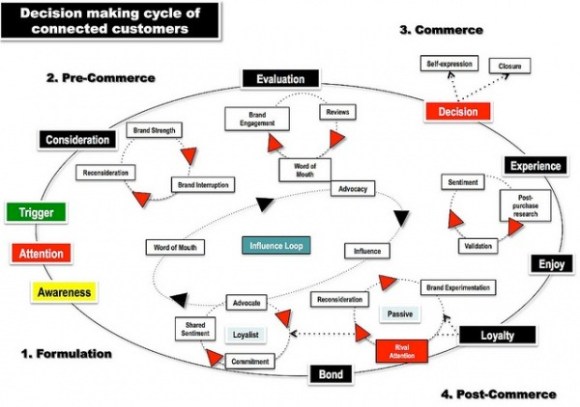
With connected customers, decision making is no longer signified by a simple funnel, nor can business models support decision making before, during, and post transaction across these distributed, connected platforms.
This is a time for augmented engagement strategies to cater to different types of customers differently, not only based on behavior but on their expectations, needs, and also the platform they use to connect and communicate.
via @BrianSolis


 Wandering Wandering Star