Categories
Wabi Sabi: The Japanese Knife
Kanso
簡素Kan — simple, so — essence.
By removing the non-essential and ornate, we can express a bare and honest simplicity. Stories told by nature is just that, unpretentious and with no need for ornamentation. Because simplicity is honest, in it we can place our trust and find comfort. Simplicity is doing more with enough, easy to understand, and not locking ourselves into predefined assumptions.
Kenya Hara (Art Director of Japanese brand MUJI) used an example of a Henckels andYanagi ba knife.
The Henckels knife fits the hand of the cook beautifully compared to the flat handle of the Japanese knife. As Kenya Hara puts it:
A flat handle is not seen as raw or poorly crafted. On the contrary, its perfect plainness is meant to say, “You can use me whichever way suits your skills.” The Japanese knife adapts to the cook’s skill (not to the cook’s thumb).
Sometimes fate is like a small sandstorm that keeps changing directions.
You change direction but the sandstorm chases you. You turn again, but the storm adjusts. Over and over you play this out, like some ominous dance with death just before dawn.
Why? Because this storm isn’t something that blew in from far away, something that has nothing to do with you. This storm is you. Something inside of you. So all you can do is give in to it, step right inside the storm, closing your eyes and plugging up your ears so the sand doesn’t get in, and walk through it, step by step. There’s no sun there, no moon, no direction, no sense of time. Just fine white sand swirling up into the sky like pulverized bones. That’s the kind of sandstorm you need to imagine.
And you really will have to make it through that violent, metaphysical, symbolic storm. No matter how metaphysical or symbolic it might be, make no mistake about it: it will cut through flesh like a thousand razor blades. People will bleed there, and you will bleed too. Hot, red blood. You’ll catch that blood in your hands, your own blood and the blood of others.
And once the storm is over you won’t remember how you made it through, how you managed to survive. You won’t even be sure, in fact, whether the storm is really over. But one thing is certain. When you come out of the storm you won’t be the same person who walked in. That’s what this storm’s all about.

Enter the New Aesthetic, imagery designed for the digital era: ‘Some architects can look at a building and tell you which version of autodesk was used to create it. The world is defined by our visualisations of it. (Someone who makes such things told me: what they put in, even as place-holders, always ends up getting built. Lorem Ipsum architecture.)’ Bruce Sterling has some thoughts on this, including the acknowledgement that this movement is unashamedly contemporary: ‘Look at those images objectively. Scarcely one of the real things in there would have made any sense to anyone in 1982, or even in 1992. People of those times would not have known what they were seeing with those New Aesthetic images. It’s the news, and it’s the truth.’ But there’s more:
First, the New Aesthetic is a gaudy, network-assembled heap. It’s made of digitized jackstraws that were swept up by a generational sensibility. The products of a “collective intelligence” rarely make much coherent sense. It was grand work to find and assemble this New Aesthetic wunderkammer, but a heap of eye-catching curiosities don’t constitute a compelling worldview. Look at all of them: Information visualization. Satellite views. Parametric architecture. Surveillance cameras. Digital image processing. Data-mashed video frames. Glitches and corruption artifacts. Voxelated 3D pixels in real-world geometries. Dazzle camou. Augments. Render ghosts. And, last and least, nostalgic retro 8bit graphics from the 1980s.
Sterling ‘nitpicks’ his way through the tropes of the genre – ‘Dazzle camouflage has nothing to do with “machine vision.” … Glitches and corruption artifacts aren’t “machine vision,” either… Satellite views are not new, but as old as the Space Age… “Render ghosts” are not “ghostly.” … Finally, retro ’80s graphics are sentimental fluff for modern adults who grew up in front of 1980s game-console machines’ – concluding that the NA is ‘a typical avant-garde art movement that has arisen within a modern network society’.
/
It is about our human reaction to machine-generated imagery, rather than the idea that machines are in some way creating and guiding this aesthetic. Our reaction to these forms of machine-age imagery is shaded by nostalgia for the impossibility of artificial intelligence. One day, someone will remake Rear Window as if it were an 8-bit game (we know, it already happened with There Will Be Blood) and the result will inspire and delight but ultimately just celebrate our attachment to the past and our endless nostalgia for the limitations of technology. We are enabling machines to emote in quasi-human ways, because that is how we want machines to be. These fictions serve our purposes.
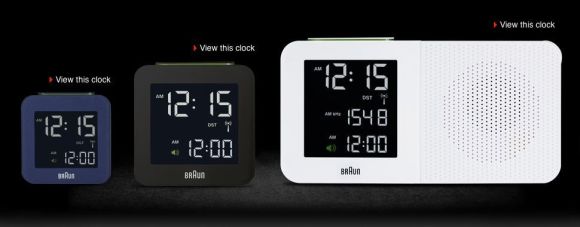
Seeing Braun clocks in different colourways is like running into Rei Kawakubo wearing Rodarte at the Brooklyn Flea. You might have paused for a few stuttering beats, but I caught that quiver of a smile before it bloomed into a full-on grin.
FontShop CS Plugin Beta from FontShop on Vimeo.
To attempt to build up theories of art, or to form a style, independently of the past, would be an act of supreme folly. It would be at once to reject the experiences and accumulated knowledge of thousands of years.
On the contrary, we should regard as our inheritance all the successful labours of the past, not blindly following them, but employing them simply as guides to find the true path.


 Wandering Wandering Star