Categories
Uncategorized

Digital Immigrants are intuitively linear, they want to see a beginning, middle, and end to stories.

For DIgital Natives, stories still need a beginning, middle and end, but they will accept it in any order. Digital Natives are subconsciously switching between platforms and can pick up different pieces of a story from different mediums in any order.

According to a new study from Time Inc. titled “A Biometric Day in the Life” shows how the proliferation of digital devices and platforms would affect the media consumption habits of consumers who grew up with mobile technology as part of their everyday lives (“Digital Natives,”) versus those who first learned about mobile technology in their adult lives (“Digital Immigrants”). Digital Natives switch their attention between media platforms (i.e. TVs, magazines, tablets, smartphones or channels within platforms) 27 times per hour, about every other minute!

Because Digital Natives spend more time using multiple media platforms simultaneously, their emotional engagement with content is constrained. They experience fewer highs and lows of emotional response and as a result. Digital Natives more frequently use media to regulate their mood; as soon as they grow tired or bored, they turn their attention to something new.

At home, Digital Natives take their devices from room to room with them (65% vs. 41% for Digital Immigrants), rarely more than an arm’s length away from their smartphones making switching platforms even easier.

54% of Digital Natives say “I prefer texting people rather than talking to them” compared with 28% of Digital immigrants, a significant indicator of how marketers and content creators need to communicate with them, says the report.

Betsy Frank, Chief Research & Insights Officer for Time Inc., concludes “… to keep Digital Natives engaged, content creators and marketers need to think differently… grabbing them… is essential, as is content they can snack on… offering multiple access points to every story.”

Basic integrated digital/social storytellling. Or, at least, seems ‘basic’ but perhaps still not universal. /  Prolly a bit simplistic to draw that  harsh terminator line between the two.  http://bit.ly/KNO3at 

HT to Wildcat2030

Categories
Uncategorized

Mr Hitchcock, what is your definition of Happiness?

As with David Lynch, anything coming out of Hitch’s mouth tenses me in anticipation of something profoundly weird or scary. And I sigh in relief when everything turns out to be just fine.

Also, need to sample this for a track someday…

Categories
Uncategorized

It is the seamless filtering in of new products or moving around of existing products which attracts consumer attention, because it gives them something to talk about. So long as there is a constant stream of newness, product shifts.

Post-recessionary spending has been hyped up to give the impression that consumers only want discounted goods. Not true, they just need pointing to what to buy.

Does this mean retailers are sacrificing margins needlessly?

Categories
Uncategorized

Facebook’s acquisition of Instagram was driven by fear, not greed. It’s no different than when Yahoo tried to buy Facebook for a billion dollars seven years ago.

It’s about taking a competitor out at the knees before they have time to actually be a competitor.

That’s not a bubble. It’s just smart.

So when Bilton says directly “When this next bubble pops — and it will pop” and gets a source to say “This is 1999 all over again, but this time, it’s gotten worse,” I just shake my head.

Tune in again in April 2013 for the next installment of the blubble.

– Mike Arrington (the opposing POV to below)

http://uncrunched.com/2012/04/30/blubble-time/

Categories
Uncategorized

Killer:  Michele Lamy video/slideshow interview: http://www.whatscontemporary.com/michelelamy/

via @dirtyflaws

Categories
Uncategorized

When small start-ups I’ve spoken with do make money, they often find it difficult to recruit additional investment because most venture capitalists — and often the entrepreneurs they finance — are not interested in building viable long-term businesses. Rather, they’re interested in pumping up enough hype and valuation to find a quick exit through an acquisition at an eye-popping premium.

Getting acquired while producing no revenue is like performing a card trick without the deck of cards: the magician simply explains how magical the trick is, never actually showing it. (And we are supposed to step back in sheer awe.)

For start-ups, fewer numbers in the equation mean a projected valuation can be plucked out of thin air.

The term often used behind closed doors with this no-revenue formula is mark-to-mystery. This is a play on the common term for a more logical investment practice called mark-to-market, which is used to create a realistic appraisal of a company’s financial assets.

“V.C.’s can create this mark-to-mystery valuation because as long as there are no numbers, I can have whatever mark I want for an external valuation of a start-up,” Mr. Kedrosky said.

Nick Bilton 
Categories
Uncategorized

budnitz no. 3 honey edition “It’s basically a 29er with 2-inch tires.”

Categories
Uncategorized

A classic rookie mistake is giving the client what they ask for, because often the client doesn’t know what is the right way to achieve their larger goal.

So even as a client comes to you and orders up a specific solution, the most important thing is to bring your intuition, experience and naiveté about the client’s request, and think deeper about how to achieve what they are trying to accomplish.

This will invariably be different then their specific request, but any company that wants to live beyond a few years and a few flashy press cycles will build products, websites or experiences that last and that outpace the original brief.

Categories
Uncategorized

the songs and dances of contemporary hunter-gatherer peoples serve them at both the individual and the group levels. They draw the tribal members together, creating a common knowledge and purpose. They excite passion for action. They are mnemonic, stirring and adding to the memory of information that serves the tribal purpose. Not least, knowledge of the songs and dances gives power to those within the tribe who know them best.

To create and perform music is a human instinct. It is one of the true universals of our species. To take an extreme example, the neuroscientist Aniruddh D. Patel points to the Pirahã, a small tribe in the Brazilian Amazon: “Members of this culture speak a language without numbers or a concept of counting. Their language has no fixed terms for colors. They have no creation myths, and they do not draw, aside from simple stick figures. Yet they have music in abundance, in the form of songs.”

Patel has referred to music as a “transformative technology.” To the same degree as literacy and language itself, it has changed the way people see the world. Learning to play a musical instrument even alters the structure of the brain, from subcortical circuits that encode sound patterns to neural fibers that connect the two cerebral hemispheres and patterns of gray matter density in certain regions of the cerebral cortex. Music is powerful in its impact on human feeling and on the interpretation of events. It is extraordinarily complex in the neural circuits it employs, appearing to elicit emotion in at least six different brain mechanisms.

Music is closely linked to language in mental development and in some ways appears to be derived from language. The discrimination patterns of melodic ups and downs are similar. But whereas language acquisition in children is fast and largely autonomous, music is acquired more slowly and depends on substantial teaching and practice. There is, moreover, a distinct critical period for learning language during which skills are picked up swiftly and with ease, whereas no such sensitive period is yet known for music. Still, both language and music are syntactical, being arranged as discrete elements—words, notes, and chords. Among persons with congenital defects in perception of music (composing 2 to 4 percent of the population), some 30 percent also suffer disability in pitch contour, a property shared in parallel manner with speech.

Altogether, there is reason to believe that music is a newcomer in human evolution. It might well have arisen as a spin-off of speech. Yet, to assume that much is not also to conclude that music is merely a cultural elaboration of speech. It has at least one feature not shared with speech—beat, which in addition can be synchronized from song to dance.

It is tempting to think that the neural processing of language served a preadaptation to music, and that once music originated it proved sufficiently advantageous to acquire its own genetic predisposition. This is a subject that will greatly reward deeper additional research, including the synthesis of elements from anthropology, psychology, neuroscience, and evolutionary biology.

On the Origins of the Arts

 
Sociobiologist E.O. Wilson on the evolution of culture
Categories
Uncategorized

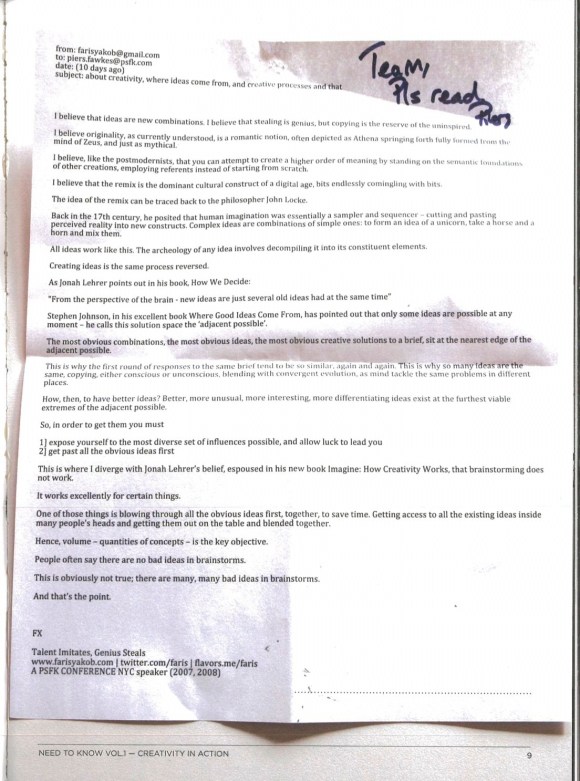
“The archaelogy of any idea involves decompiling it into its constituent elements. *Creating* ideas is the same process reversed.” – @faris 

… how, then, to have better ideas? 

1) Expose yourself to the most diverse set of influences possible, and allow luck to lead you.

2) Get past all the most obvious ideas first. (And brainstorms can be effective for this fast-filtering)