Categories
Uncategorized

What I “discovered” was that happiness is not something that happens.

It is not the result of good fortune or random chance. It is not something that money can buy or power command. It does not depend on outside events, but, rather, on how we interpret them. Happiness, in fact, is a condition that must be prepared for, cultivated, and defended privately by each person. People who learn to control inner experience will be able to determine the quality of their lives, which is as close as any of us can come to being happy.

The implication being, the quality of your life (and thus, your happiness), is a choice. It’s something that you decide you want, and something you create for yourself.

 Flow by Mihaly Csikszentmihalyi

http://jtaby.com/2012/02/02/a-moment-of-clarity.html

Categories
Uncategorized
Categories
Uncategorized

THE PARIS REVIEW:

For someone who so often writes about the future of technology, you seem to have a real romance for artifacts of earlier eras.

WILLIAM GIBSON:

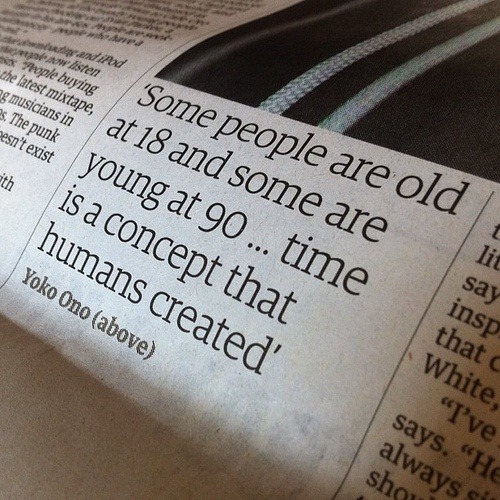
It’s harder to imagine the past that went away than it is to imagine the future. What we were prior to our latest batch of technology is, in a way, unknowable. It would be harder to accurately imagine what New York City was like the day before the advent of broadcast television than to imagine what it will be like after life-size broadcast holography comes online. But actually the New York without the television is more mysterious, because we’ve already been there and nobody paid any attention. That world is gone.

My great-grandfather was born into a world where there was no recorded music. It’s very, very difficult to conceive of a world in which there is no possibility of audio recording at all. Some people were extremely upset by the first Edison recordings. It nauseated them, terrified them. It sounded like the devil, they said, this evil unnatural technology that offered the potential of hearing the dead speak. We don’t think about that when we’re driving somewhere and turn on the radio. We take it for granted.

Categories
Uncategorized

Categories
Uncategorized

Benga “I will never change”

Categories
Uncategorized

… the art of storytelling is in the magic of REframing the narrative.

That is the moment of spontaneous combustion—the Frankenstein spark—that brings the narrative to renewed and eternal life. 1st Frame: here’s our protagonist. 2nd Frame: something (typically out of the ordinary) happens. 3rd Frame: the protagonist “acts” within the new (unexpected) scenario. 4th Frame: here’s our protagonist, again. But action having been taken, providing some sort of resolution to the previous scenario, we see the 1st Frame with different eyes. Or at least, in remembering the beginning as best we can, we sit it differently; we have new information, we reframe the frame.

Is this really magic? No, it’s design, carefully crafting the narrative, in Hitchcock’s case, through highly controlled storyboarding techniques.

The frame and reframe technique of storytelling is even more thrillingly illustrated in Akira Kurosawa’s 1950 murder mystery, Rashomon, in which the audience is shown the same disturbing story of rape and murder from four different protagonist’s points of view, concluding with a fifth vantage point, so that each frame, and then reframe, is ultimately RE-reframed from every participant’s perspective. Dizzying but exhilarating. The initial gloomy overcast of rape and murder is erased by the illuminating blue sky (albeit black and white) of the director’s final framing.

Framing vs. RE-Framing. Expanding on Nussbaum’s “Narrative, Engagement, ‘What-if’ and ‘Radical Blue-Sky’ framing.
Categories
Uncategorized

Categories
Uncategorized

Categories
Uncategorized

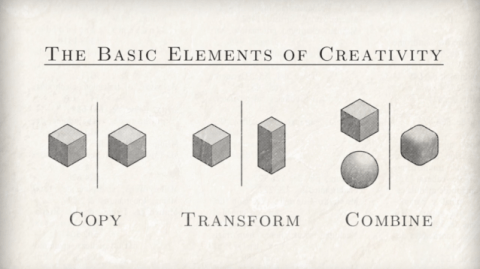
The deepest appreciation of things comes from making them.

Hate that writing? Write something better. Don’t like those ideas? Outline your own. Dislike that music? Write better music (this is the *exact* reason I wrote my album).

At first, your taste will exceed your ability to create. But over time, creating, you will develop an intense and long-lasting appreciation for all kinds of creative works – without losing your selectivity. Your selectivity, instead of being puerile and facile, quick and shallow, will be deep, considered, and as solidly grounded on merit as it is in flaws.

In time, you may come to love yourself as a creator instead of despising yourself as a selector.

In short – if you can’t find anything you like, make things for yourself to like.

 http://bit.ly/JNK9uQ 
Categories
Uncategorized

Let’s start with what most people probably can agree.

Information is accumulating online. The amount of available information is increasing at an exponential rate, some say it doubles every second year. This mean that any illusion of being able to stay up to date with everything that is going on is utopian and has been probably since Gutenberg invented the press.

Most people know this, yet that is exactly exactly what we all seem to be doing.

There is no shortage of content aggregators and aggregators of aggregators, daily developed to give us a better overview of all the sources of information we have subscribed to and found ourselves now depending on.

This has resulted in an endless stream of articles, news, pictures, websites, products, updates, comments of updates and comments to these comments, being delivered to us second by second that each of us have to deal with.

Constantly checking our feeds for new information, we seem to be hoping to discover something of interest, something that we can share with our networks, something that we can use, something that we can talk about, something that we can act on, something we didn’t know we didn’t know.

It almost seems like an obsession and many critics of digital technology would argue that by consuming information this way we are running the danger of destroying social interaction between humans. One might even say that we have become slaves of the feed.

At every point in human history there have been philosophers claiming that the current civilization has fallen from an earlier halcyon state, that the ways of the ancients had been lost, and modern innovations and practices threatened to destroy all that was good in society and culture.

This thread of Western philosophical discourse — attention scarcity, future shock, information overload — has become the conventional wisdom. It seems to be based on unassailable and unshakable logic. But what is that logic?

The framing of the argument includes the unspoken premise that once upon a time in some hypothetical past attention wasn’t scarce, we didn’t suffer from too much information, and we had all the time in the world to reason about the world, our place in it, and therefore to make wise and grounded decisions.

But my reading of human history suggests the opposite. In the pre-industrial world, business people and governments still suffered from incomplete information, and the pace of life always seemed faster than what had gone on in earlier times. At every point in human history there have been philosophers claiming that the current civilization has fallen from an earlier halcyon state, that the ways of the ancients had been lost, and modern innovations and practices threatened to destroy all that was good in society and culture. 

So, this is merely the most recent spin on an ancient theme, as the Diderot quote indicates.

Imagine for a moment that it is true — there was an idyllic time back in the Garden of Eden — when we knew all that was necessary to know, and we had all the time in the world to make decisions. Maybe. I am betting it is a shadow of our psychology, the same sort of magical thought that believes in guardian angels and reincarnation. Just a slightly more intellectual superstition.


-Stowe Boyd   The false question of attention economics