Categories
Uncategorized

Ven Rao’s Manufactured Normalcy Field: The sense that the present will last a good while into the future.

Instead of the continuous creative destruction mindset, where the present is being relentlessly consumed by the future, which is only a few weeks, days, or minutes from now.

But the bigger the company, the more likely they are to act as if the present is eternal, and the future is retreating as fast as they amble forward.

Categories
Uncategorized

“I think records were just a little bubble through time and those who made a living from them for a while were lucky.

There is no reason why anyone should have made so much money from selling records except that everything was right for this period of time. I always knew it would run out sooner or later. It couldn’t last, and now it’s running out.

I don’t particularly care that it is and like the way things are going. The record age was just a blip. It was a bit like if you had a source of whale blubber in the 1840s and it could be used as fuel. Before gas came along, if you traded in whale blubber, you were the richest man on Earth. Then gas came along and you’d be stuck with your whale blubber. Sorry mate – history’s moving along. Recorded music equals whale blubber. Eventually, something else will replace it.”

Categories
Uncategorized

call-stack:

jtotheizzoe:

iomikron:

Studying the reblogging

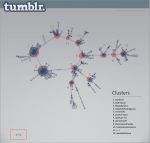
These graphs represent the network created by tumblr bloggers who reblogged a previous post of mine. The first graph corresponds to the network formed after 2 days, and the second one is the same network after 3 days. In both networks, there are some clusters, where a blogger reblogs my post and after that successive rebloggings are occuring from his/her followers. I created a little program in Mathematica, which can read the notes of the post and identify who reblogged from whom.

I have attributed a name to some of these clusters  by the name of the blog located in the root of the cluster. For example, my cluster is the number 1. The biggest cluster though, for the first graph, is that of jtotheizzoe. For the second graph, the huge cluster is that of n-a-s-a, which has its origin from the jtotheizzoe’s cluster (number 2)… The seperated couples at the bottom are users that have reblogged my post by the ‘likes’ list’ of the other user, and then I couldn’t know where they came from…

I really enjoy that, and I’m curious how the structure of the network will look like eventually…

This a very cool analysis of Tumblr post spread. It’s very interesting to see how content spreads over days from the original poster, and how its life span and amplification change. It’s sharing, visualized.

I’m happy to be a node on this, as well.

I have wanted to write something to do this for a while now.

Categories
Uncategorized

The Company with the Smartest Consumer Community Wins. Here’s Why.

Networked technologies lower the threshold of participation, create more modularity and granularity in products and services, relocalize physical production, and create new production models that scale fast and more efficiently than traditional models. This raises serious questions for executives about how to help their companies capitalize on the transformation underway. 

Yesterday, the majority of competition was symmetrical: between players with relatively evenly matched resources and capabilities. Think Ford v. GM, P&G v. Unilever, or K-Mart v. Sears. While new entrants have always challenged these incumbents, it’s different now:

  1. Rarely before have new entrants upset incumbents so decisively — to actually put them out of commission. (i.e. 244–yr old Britannica v. 11–yr old Wikipedia).
  2. Never have entrants dominated entire industries with such speed (i.e. Facebook’s domination of not just the social media industry but the entire Internet).
  3. Never before have so little resources been needed to compete (i.e. Airbnb v. hotels)
  4. Never before have so many revolutionaries threatened so many incumbents across a broad sweep of industries.

In short, the Law of Asymmetrical Competition states that closed, hierarchical organizations will lose to those entrants who collaborate with their user communities via networked technologies. The work of physicist Geoffrey West, of the Santa Fe institute, proves why. He shows that companies scale SUB–LINEARLY. Their slope is .75, which means that, at each point of growth, a company has 25% less innovation (among other things) than they previously did. However, social networks scale SUPER–LINEARLY. Their slope is 1.15 meaning that, at each point of growth, networks have 15% more innovation (among other things) than they previously did. 

The broad message of P2P design is that organizations need to respond. They must incorporate an understanding of networks into their strategic thinking and hire leaders to design and integrate these new means of business. In the long run, a deliberately designed loss of control grants companies the only remaining and arguably most critical competitive advantage: access. As long as they enable and facilitate knowledge flows, ideas, passions, skills, and innovations among social networks, they have access to them. The truth is this: the company with the smartest consumer community wins. In fact, McKinsey discovered this to be true. Surveying global executives, the firm found that deploying networked technologies to foster mass collaboration is highly correlated with market share gains.

Categories
Uncategorized

The best technology is aimed far enough in the future that it stands out, but close enough to the present that it blends in.

@levie
Categories
Uncategorized

Categories
Uncategorized

Categories
Uncategorized

Categories
Uncategorized

Trying, trying…

Move from managing by command and control to inspire and support – It takes courage to change the way you do things and to be radically transparent about what works and what doesn’t. You still need to measure the right things but innovation, by its nature, is full of insecurity. Focus on getting everyone on the team involved.

Categories
Uncategorized

“I am always doing that which I cannot do, in order that I may learn how to do it.”

One commonality that Pablo Picasso shares with other creative geniuses, according to biographical accounts, is that they all have a “childlike” way of seeing familiar things as if for the first time.

He was constantly “present” in his everyday life and, like a child, saw the hidden beauty of the world by not analyzing, labeling and judging the people and things in his environment. This might sound strange but in the moments when you are “present” the ordinary world becomes more interesting and wonderful. Colors can seem brighter. You see more aliveness in trees, nature and in people. You see the wonder of being alive. Things that most often seem common, routine and boring become fascinating and something you can appreciate.