Categories
Uncategorized

A Dozen Things Charlie Munger has said about Reading

1 “In my whole life, I have known no wise people (over a broad subject matter area) who didn’t read all the time – none, zero.”

2 “You’d be amazed at how much Warren reads – at how much I read. My children laugh at me. They think I’m a book with a couple of legs sticking out.”

3 “As long as I have a book in my hand, I don’t feel like I’m wasting time.”

4 “I’ve gotten paid a lot over the years for reading through the newspapers.”

5 “I don’t think you can get to be a really good investor over a broad range without doing a massive amount of reading. I don’t think any one book will do it for you.”

6 “For years I have read the morning paper and harrumphed. There’s a lot to harrumph about now.”

7 “We read a lot.  I don’t know anyone who’s wise who doesn’t read a lot.  But that’s not enough: You have to have a temperament to grab ideas and do sensible things.  Most people don’t grab the right ideas or don’t know what to do with them.”    

8 “By regularly reading business newspaper and magazines I am exposed to an enormous amount of material at the micro level.  I find that what I see going on there pretty much informs me about what’s happening at the macro level.”  

9 “Warren and I do more reading and thinking and less doing than most people in business. We do that because we like that kind of a life. But we’ve turned that quirk into a positive outcome for ourselves. We both insist on a lot of time being available almost every day to just sit and think. That is very uncommon in American business. We read and think.”

10 “If you get into the mental habit of relating what you’re reading to the basic structure of the underlying ideas being demonstrated, you gradually accumulate some wisdom.”

11 “Develop into a lifelong self-learner through voracious reading; cultivate curiosity and strive to become a little wiser every day.”

12 “I met the towering intellectuals in books, not in the classroom, which is natural. I can’t remember when I first read Ben Franklin. I had Thomas Jefferson over my bed at seven or eight. My family was into all that stuff, getting ahead through discipline, knowledge, and self-control.”

p.s., “Obviously the more hard lessons you can learn vicariously, instead of from your own terrible experiences, the better off you will be. I don’t know anyone who did it with great rapidity. Warren Buffett has become one hell of a lot better investor since the day I met him, and so have I. If we had been frozen at any given stage, with the knowledge we had, the record would have been much worse than it is.
**So the game is to keep learning**”


// Amen. 

Categories
Uncategorized

.

Q: You once said success is a lousy teacher. What did you mean by that?

A (Bill Gates): Anybody who’s super-successful has been misled a little bit. They don’t really know the actual magic factors of luck and skill that led them to this wonderful success. Hopefully they’re engaged in an effort where they have lots of failures, things that try and don’t work.

//We absolutely tend to spotlight successes. In business, on LinkedIn profiles, in portfolios, in the news, in 9-figure funding valuations, with self-congatulatory Medium posts camouflaged as case studies, in parenting, in pre/kinder/grade/mid/hi school… 

However, in coaching, or in the studio, we learn the value of iteration within a context of critical evaluation, of why improvement is needed, why an attempt failed, why success is elusively malleable and whose opinion of good you should sometimes/always/never-ish listen to. 

There is a priority awarded to the awareness of why you succeeded, or failed; in that action, in that moment, with that piece, with the gestalt of the effort. Because it’s that awareness, evaluation and iteration, that you take with you, outside the court, the pitch, the track, the field, the canvas, the monitor, the page, the studio, every single day.

Categories
Uncategorized

.

//NLP exercise: Replace ‘programming’ with ‘design’, ‘programmers’ with ‘designers’.

“Why is software so expensive?” An explanation to the hardware designer.

https://www.cs.utexas.edu/users/EWD/transcriptions/EWD06xx/EWD648.html

“To educate a generation of programmers with a much lower threshold for their tolerance of complexity and to teach them how to search for the truly simple solution is the second major intellectual challenge in our field. This is technically hard, for you have to instill some of the manipulative ability and a lot of the good taste of the mathematician. It is psychologically hard in an environment that confuses between love of perfection and claim of perfection and, by blaming you for the first, accuses you of the latter.

How do we convince people that in programming simplicity and clarity —in short: what mathematicians call “elegance"— are not a dispensable luxury, but a crucial matter that decides between success and failure? I expect help from economic considerations. Contrary to the situation with hardware, where an increase in reliability has usually to be paid for by a higher price, in the case of software the unreliability is the greatest cost factor. It may sound paradoxical, but a reliable (and therefore simple) program is much cheaper to develop and use than a (complicated and therefore) unreliable one.”

Categories
Uncategorized

Preach.

//platform.twitter.com/widgets.js

Categories
Uncategorized

There are two core drivers of economy-wide unbundling [of incumbent corporations by startups]

1. [Startups] are essentially product design teams that are focused on iterating fast to find product-market fit.

They are able to offer fundamentally better products and services than the incumbents because of the product-centric DNA of the management teams. They usually focus their product development on a sub-segment of the millennial demographic because millennial customers don’t have much loyalty to existing brands. Whether it’s consumer packaged goods or financial services, these customers are willing to try new brands and share their experiences openly with each other through rankings and reviews. As a result, momentum builds fast behind companies whose products and services are truly better in the consumers’ minds.

2. These [startups] rent all aspects of operational scale from partners and eliminate any capital expenditures or operational inertia from their execution plans.

They are therefore designed for growth, especially given their lean organizational structures. For manufacturing, logistics, customer acquisition, and commerce, there are third party services and APIs available to scale with customer demand as quickly as necessary. Once these companies have built a relationship with their customers, they quickly go on to re-bundle products and services to increase their share of the customer’s wallet.

This is a structural change. Today’s innovative companies also run the risk of being disrupted by a new generation of nimble upstarts that will use the very same unbundled business model to their advantage. Businesses will need to persistently focus on product and customer success, because for most firms scale isn’t a moat any more. (The monopolistic advantages of scale are shifting to platform companies like Amazon, Facebook, Apple Pay and YouTube. These platform companies are becoming essential to how the economy functions, as power companies and internet service providers have been for decades.)

// HBR succinctly sums up ‘unbundling’ for its readers.

Categories
Uncategorized

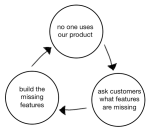
The “Product Death Cycle” diagram

1) No one uses our product
The natural state of any new product is that no one’s using it 🙂 So that’s not a problem in itself. However, the way you react to this problem is what causes the Product Death Cycle.

2) Ask customers what features are missing
One of the big early mistakes is to be completely user-led rather than having a product vision. This manifests itself in asking users “What features are missing?”

Here are the problems with this approach:

• Users who love your product now may not represent the much larger market of non-users who’ve never experienced it. So the feedback you get might be skewed towards a niche group, and the features they suggest may not be mainstream
• User research is great for coming up with design problems, but you can’t expect users to come up with their own design solutions. That’s your job! They may be stuck in a certain paradigm and won’t have the tools/skills to come up with their own solutions. Faster horses and all that
• “What features are missing?” assumes that just adding more features will somehow fix the problem. But there are many, many other reasons why your product may not be working- maybe the pricing is wrong. Or it’s not being marketed well, the activation is broken, or the positioning sucks, etc.

Instead of asking for what’s missing, instead the solution is to ask- what is the root cause of users not using the product? Where’s the fundamental bottleneck? In a world where 80% of daily active users are lost within 30 days, there’s a lot of reasons why users are bouncing before they even get into the “deep engagement features” you’ve built out. Asking engaged users what features they want won’t help much- instead you’ll likely get a laundry list of disorganized features that will push you towards your competitors.

3) Build the missing features
The second jump in the Product Death Cycle is to take features that customers have suggested, and just build the missing features. However, this quickly falls into the Next Feature Fallacy, which is the mistaken belief that just adding one more new feature will suddenly make people want to use your whole product.

Losing 80% of mobile users is normal. [Most] interaction with a product happens in the first few visits. That’s where you can ask the user to setup for long-term retention and to present the user with a magic moment. Building a bunch of “missing” features is unlikely to target the leakiest part of the user experience, which is in the onboarding. If the new features are meant to target the core experience, it’s important that they really improve the majority workflows within the UI, otherwise people won’t use them enough to change their engagement levels.


[How to fix?]

To break out of this part of the Product Death Cycle, ask yourself- is this enough of a change to influence the experience? Is it far enough “up the funnel” to impact the leakiest parts of the product experience? Is this just another cool feature that only a small % of users will experience?

The Product Death Cycle is tricky because it’s driven by the right intentions: Listen to customers and build what they want. People in the Product Death Cycle naturally believe that they are doing the right things, but good intentions don’t translate to good traction. Instead, ask “why?” over and over, to understand the root cause for lack of growth.

The response to these root causes should consist of a large toolkit of responses- maybe marketing: Pricing, positioning, distribution, PR, content marketing, etc. Maybe it has to do with the strategy: Going high-end instead of low-end. Building a utilitarian product instead of a network-based one, or vice versa. The point is, the solution should be tailored to the root cause, rather than to be explicitly driven by the desire of every product team to build more product.

– @andrewchen X @davidjbland’s Product Death Cycle diagram)

// there are corollary diagrams related to ‘traditional’ advertising and marketing, just waiting to be napkin-drawn with a skinny black marker…

while ‘physical product death’ has an incredibly long tail in secondary markets (eBay, garage sales, flea markets), retro fandom, collectors and museums.

Categories
Uncategorized

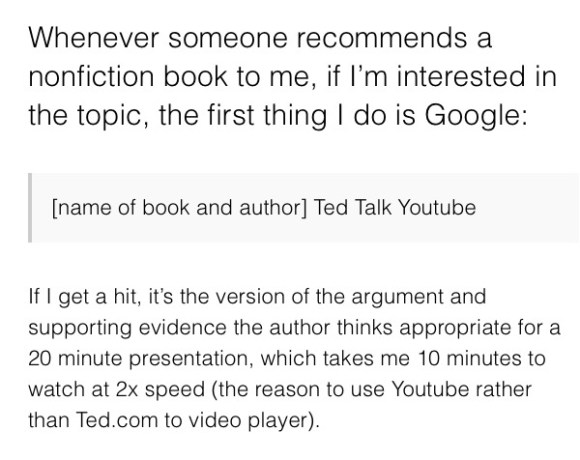
// Andrew Kortina actually watches the TED talk. I recommend skimming their awesome text transcript first. If I get pulled in, then I watch. Often, I save for later.

Manage your inputs. Periodically and ruthlessly iterate on your ‘edit and filter’ loops. Unplugging is as essential as refactoring – this helps avoid those preachy Medium posts about how you took a week/month/year off the internet and swore off Instagram and the iPhone.  

Categories
Uncategorized
Categories
Uncategorized

“We all have the natural human tendency to take the safe route — to do the thing we know will work rather than taking a chance. 

But that’s the antithesis of jazz, which is all about being in the present. 

Jazz is about being in the moment at every moment. It’s about trusting yourself to respond on the fly. 

If you can allow yourself to do that, you never stop exploring, you never stop learning, in music or in life.”

– Herbie Hancock

https://medium.com/cuepoint/rockit-revisited-how-herbie-hancock-crafted-a-hip-hop-classic-12cd19406ca5

Categories
Uncategorized

.

I love fashion. There is such a common misconception that I/Meadham Kirchhoff is anti-fashion, and that I/we/it hates fashion and the fashion ‘industry’. Not true. Well, not entirely. I love clothes, I love dressing, I love the transformative potential in clothes. I love ideas. I love craft. Like, I get that we are in some kind of dreadful recession, one which has lasted years. I get that people have less money to buy clothes, or at least that they are more reluctant to do so. I get that this in turn has left stores in a precarious position. I know this from being on the receiving end of it. Designers are the lowest common denominator in the fashion ‘industry’.

What I find frustrating, disappointing and fucking depressing about the fashion ‘industry’ nowadays is the general sense of apology and – worse – apathy that I see and feel across the fashion capitals. Nobody seems to believe in fashion now, especially not those who are supposed to love it the most. ‘We’ are so bored by the un-inspired clothes we are presented with – that focus shifts to shallow ideas of political expression: fleeting, ephemeral gestures towards feminism, issues of gender, even its association with art and artists; fashion, in its own lack of self-belief and insecurity, trying to gain some validation and some semblance of credibility.

I wish instead that during these times where, realistically, it seems that clothes are not going to be produced and sold in volume, that designers and stores – the ‘industry’ at large – would focus on what is important, i.e. progression of ideas, moving fashion forward, and seeing and feeling something new. The entire way that fashion is presented – the models, the show, and not least the clothes themselves – has barely changed since the early to mid-20th century, like 70-plus years or something. Fashion has become stagnant, set in its own self-imposed ideas and formulas. We need to rethink. Fashion needs a revolution!

Fashion can be and has been an important social barometer, a reflection of society and social change. Fashion can be and has been an important part of culture in general, from street culture to haute couture. Fashion may not be ‘art’, but it is an art form, an environment for ideas and the progression of them. This seems to be a neglected fact in this era of dumbed-down pre-collections aiming to please and speak to everyone, but seemingly appealing to none. We may exist in an economical recession, but do we need to live in a creative one? Can this era not allow us the time to evolve?

In the 50s, somebody decided that clothes only look good on 6ft tall, emaciated teenagers. ‘We’ are still entirely indoctrinated into this way of thinking; this one way of seeing fashion, which to me feels so last century, so archaic and boring. When we presented the last Meadham Kirchhoff collection, Reject Everything, it was intended as a call to arms against all that, which feels to me now to have become so irrelevant. Not only the formulaic structure of a typical fashion show, but the fucking repulsive modelling industry, the old-fashioned, out-of-date concepts of appropriate dressing, the ridiculously limiting boundaries of gender and sexes, and all of the rules which go together with that.

It’s a reaction against a society in general, which – like fashion – chooses to remain oblivious to these real issues, which affect our daily lives. The fact that women are still not paid equally to men, that even though gays have now been afforded the ‘right’ to marry and assimilate into hetero normative mainstream culture, AIDS and HIV are depressingly rampant. But socially ‘we’ choose to ignore these simple important facts, issues which we as people – disgusting human beings – actually do have the power to change and improve our individual daily lives. Instead ‘we’ as a society prefer to ignore these issues in favour of environmental issues, which realistically we can do nothing about.

For me, this is all part of the human race’s self-obsession: that ‘we’ as a people have killed the planet, and that in turn we can save it, ignorant of the fact that the Earth has changed and evoked for millennia of its own accord, in spite of the humans. 

Who cares if we as a race exist in twenty or a hundred years, when we live in shit now? For me, fashion – clothes – is a part of all of this. Clothing is a tool for us to express ourselves and our individualities. Our culture has always demeaned the potential social and personal impact that fashion can have because our society considers fashion to be a ‘woman’s’ concern and interest, i.e. shallow and insignificant.

In the 20s (nearly one-hundred years ago!) Chanel and Vionnet released women’s bodies from the tyranny of corsetry and under-structure, allowing women to move and breathe freely for the first time perhaps since the inception of clothing. 

In the early-mid 70s, Vivienne Westwood revolutionised the entire concept of appropriate dressing and the construction of clothes, revealing seams and raw edges, and disrupting social ideas of how and what was acceptable modes of dress. 

Both of these instances (almost exclusively these two alone) had incomprehensible effects upon our culture and society, and more importantly the lives of the wearer of those clothes, and of the brains of the observers of the people who wore them. 

Fashion does have that power. Well, it used to. We just all need to fucking remember that.

– “activist designer duo” Meadham Kirchhoff


// As a designer living and working in technology and advertising, fashion rarely merited awareness in the workplace. One of our guilty pleasures in the recent move back to NYC from SF, was the freedom from the visual tyranny of startup t-shirts. So the call-to-arms for a transformative and radical change to fashion, is refreshing and invigorating. 

Remember, that not so long ago, ‘design’ and the ‘customer/user experience’ was a frustrating Sisyphean struggle for attention. It was really only when *that* consumer electronics company started evolving into  mechajuggernauthood that design became a desire, a necessity, and a force, within and without technology companies, VC’s and the media. 

There is tremendous value in design. Fashion does need a revolution. Just perhaps not in a disruption-via-generic-mass-produced-just-in-time-operations-or-flash-sale-of-the-moment-but-please-let-NYC-have-another-giant-sized-startup-exit-liquidity-event way.