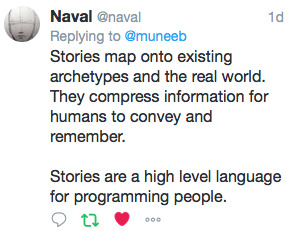
“Stories are a high level language for programming people.”
“Stories are a high level language for programming people.”
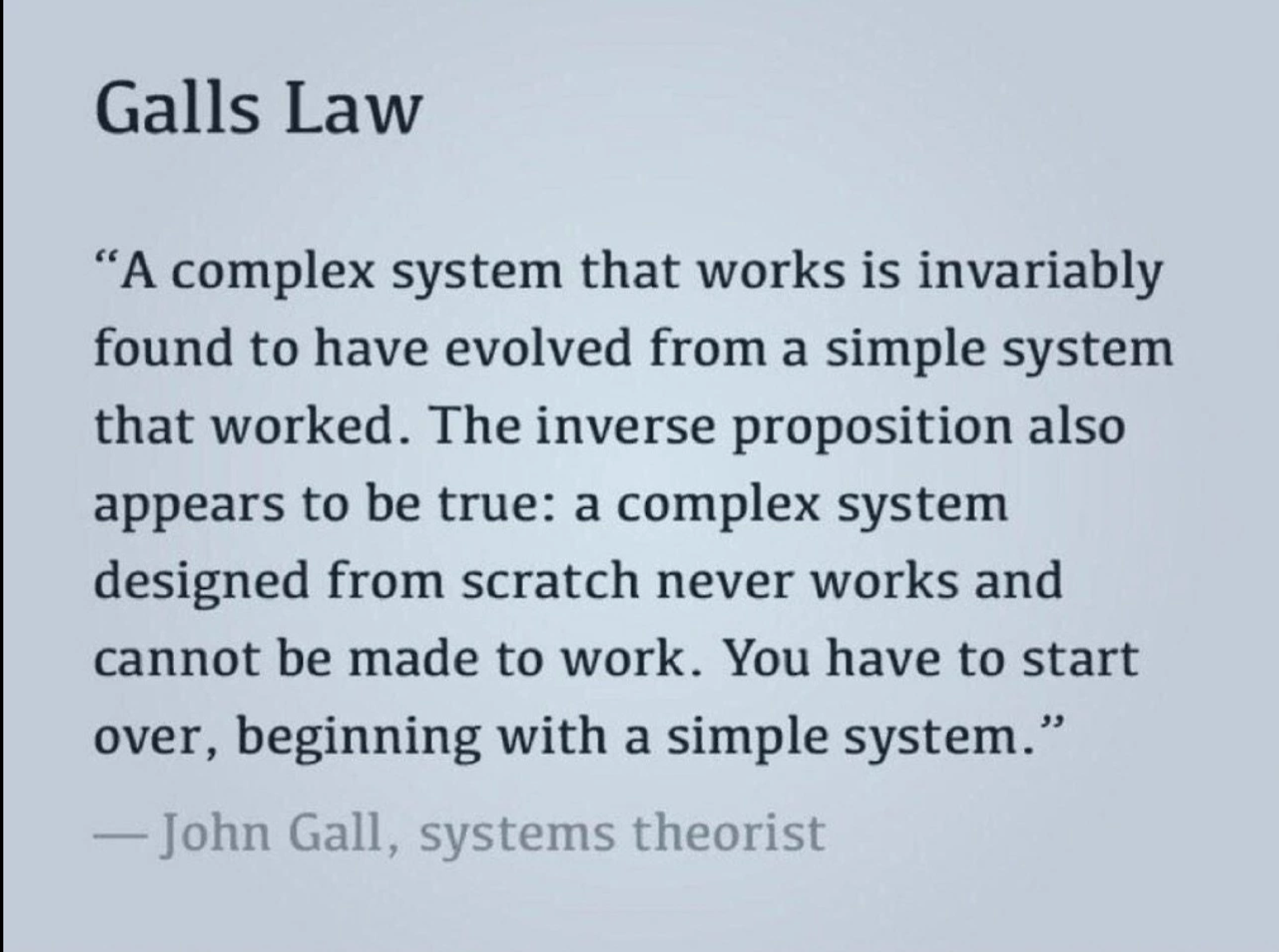

Startups, product design, parenting, organizational design, process design, marriage, friendships… life, basically 😉

Creativity researchers Howard Gruber and Sara Davis see a strong link between the most creative people and their tendency to work on multiple projects.
…
Gruber and Davis have coined a term for this melting pot of different projects at different stages of completion, they call it a ‘network of enterprises’. They argue that the parallel project approach has four benefits:
1. Multiple projects cross-fertilize. The knowledge gained in one enterprise provides the key to unlock unlock another.
2. A fresh context is exciting; having several projects may seem distracting, but instead the variety grabs our attention—we’re like tourists gaping at details that a local would find mundane.
3. While we’re paying close attention to one project, we may be unconsciously processing another—as with the cliché of inspiration striking in the shower. Some scientists believe that this unconscious processing is an important key to solving creative problems. John Kounios, a psychologist at Drexel University, argues that daydreaming strips items of their context. That’s a powerful way to unlock fresh thoughts. And there can be few better ways to let the unconscious mind chew over a problem than to turn to a totally different project in the network of enterprises.
4. Each project in the network of enterprises provides an escape from the others. In truly original work, there will always be impasses and blind alleys. Having another project to turn to can prevent a setback from turning into a crushing experience. The philosopher Søren Kierkegaard called this “crop rotation.” One cannot use the same field to grow the same crop indefinitely; eventually the soil must be refreshed, by planting something new, or simply taking a break.
Gruber and Davis argue that with the right network of enterprises, an impasse in one project can end up feeling somewhat liberating. If you fall down the wrong rabbit hole you have the ability to pivot to something fresh.
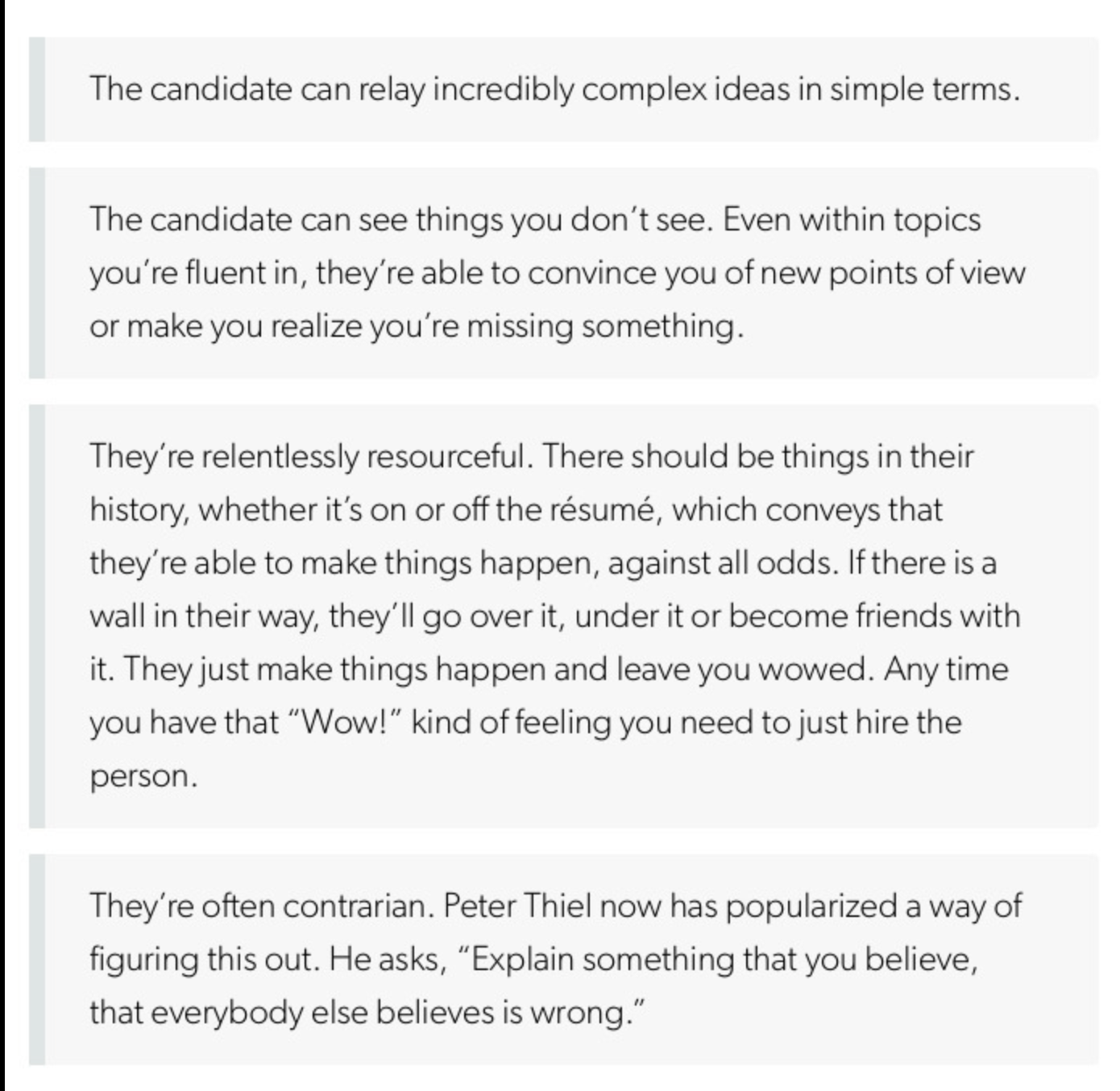
// @rabois on identifying undiscovered talent
/debunking the ‘robot overlords’ anxiety…
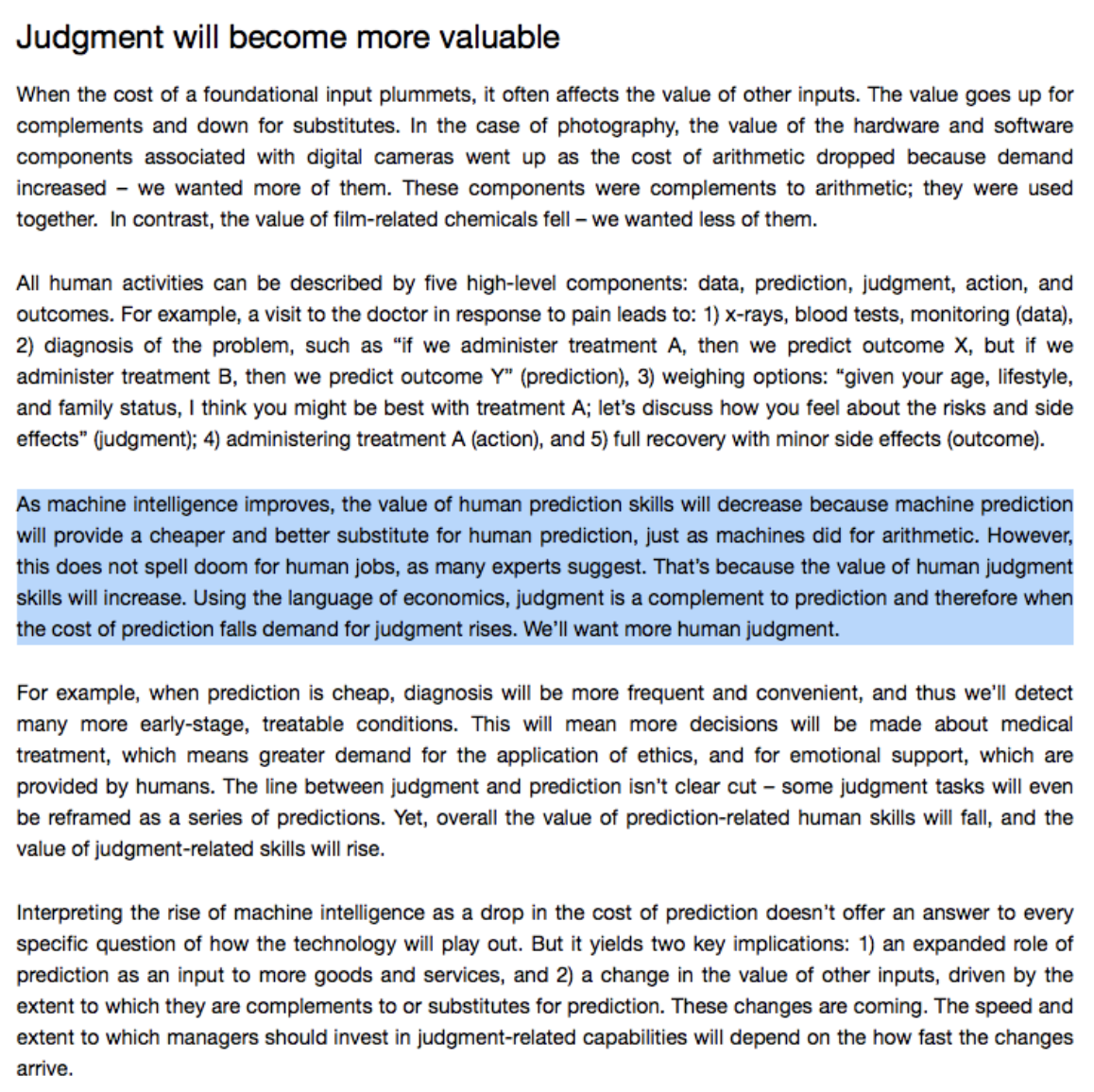
“As machine intelligence improves, the value of human prediction skills will decrease because machine prediction will provide a cheaper and better substitute for human prediction, just as machines did for arithmetic.
However, this does not spell doom for human jobs, as many experts suggest. That’s because the value of human judgment skills will increase.
Using the language of economics, judgment is a complement to prediction and therefore when the cost of prediction falls demand for judgment rises.
We’ll want more human judgment.”
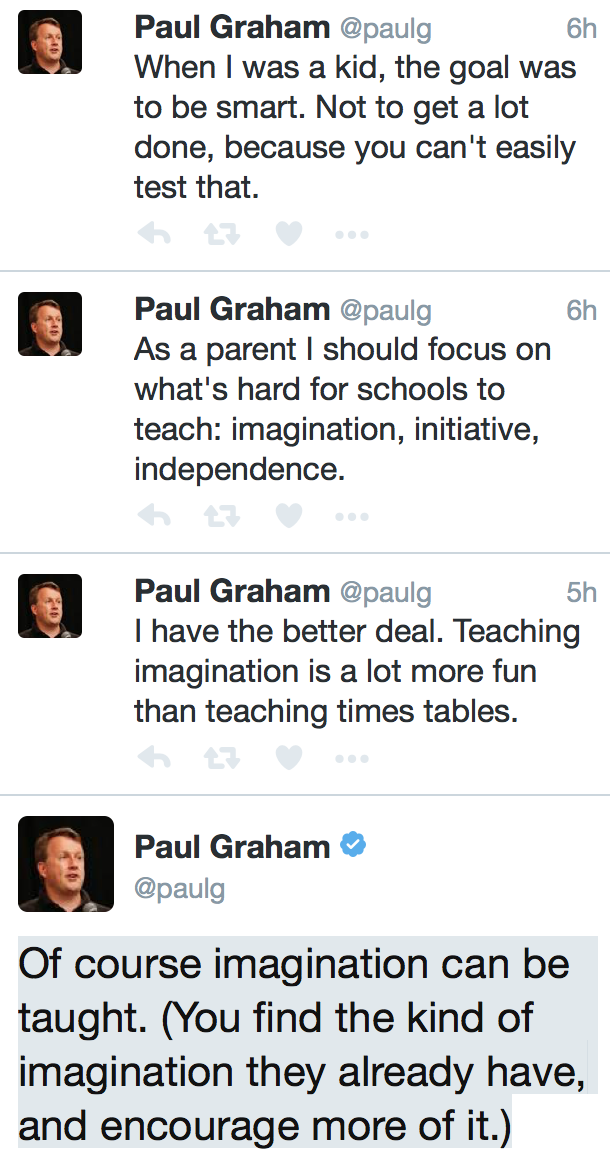
“Of course imagination can be taught.
(You find the kind of imagination they already have, and encourage more of it.)”
– Paul Graham on parenting.
//Coincidentally, also infinitely extensible for all of us working collaboratively in ‘creative’ fields and . Helping others. Making, problem-solving, trying, testing, blowing it all up, and starting over
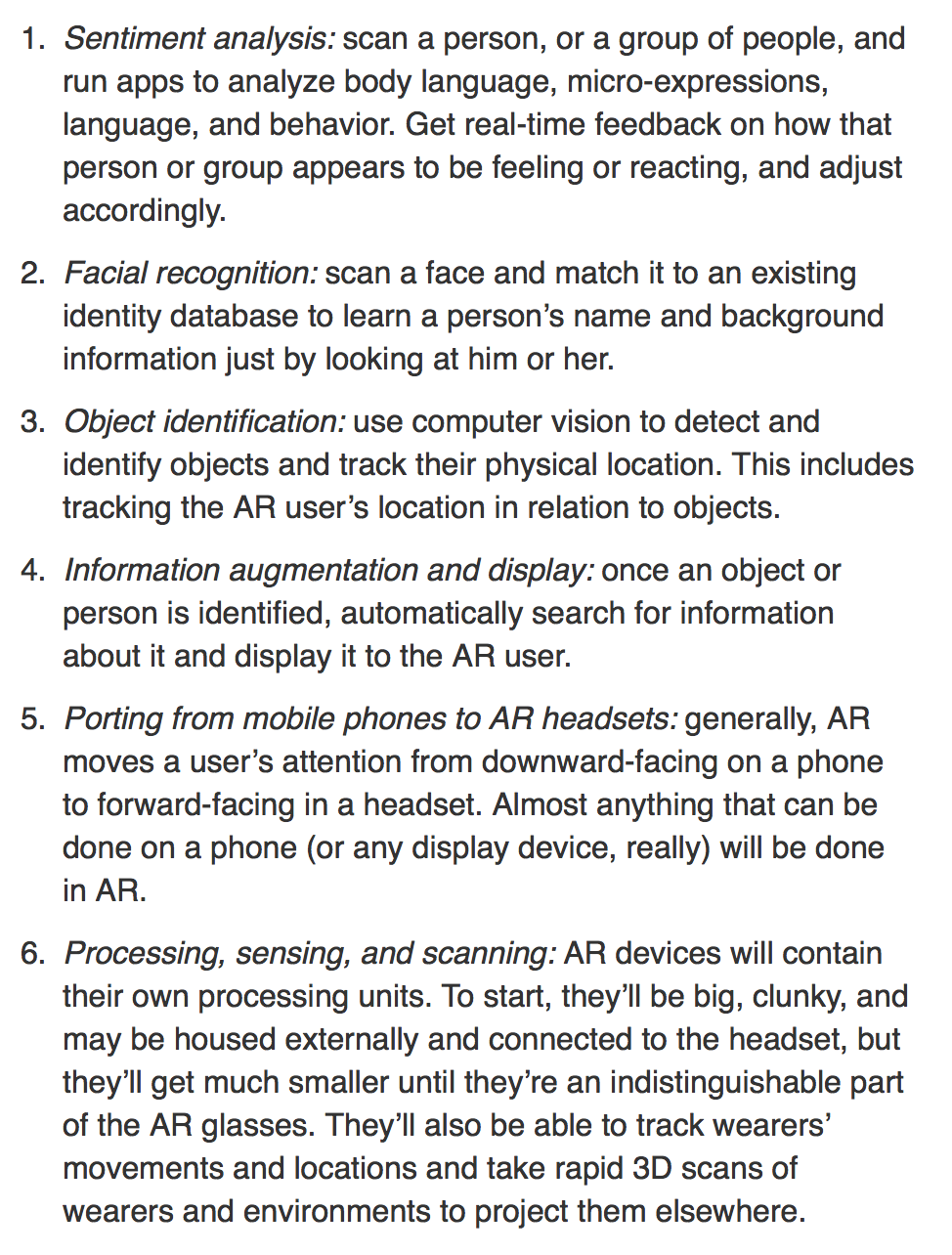
/Comparing ‘AR’s key concepts’ with our current set of Machine Learning tools/APIs. The overlaps are interesting. As are the gaps.

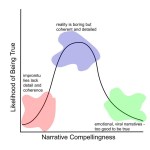
.
The Theory of Narrative Selection
Why do some stories become popular, retold for hundreds of years, while others are forgotten? Why do you see the particular stories that you see in your social media feed and on the news? How can we tell whether stories are true? And why are false stories so maddeningly popular?
… stories as if they were biological organisms. Stories can’t reproduce themselves; they rely on humans for their survival and reproduction. In that sense, stories are symbiotic (or perhaps parasitic) in their relationship with humans. New stories are constantly being invented, using existing and novel devices and elements. They take as their subject matter factual happenings, imaginings, or both. They are transmitted and retold at different rates; most stories peter out and die, while a few sweep across the world in hours. They exhibit all the hallmarks for natural selection to act: variation, differential survival and reproduction, and heritability. Reproduction is complicated. Stories may transmit copies of themselves (reprintings, oral retellings), or they may transmit their traits to new generations of stories.
bit.ly/1UlwIodbit.ly

 Wandering Wandering Star