Categories
Uncategorized

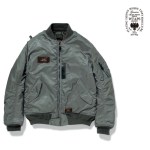
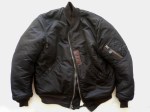
…the legend is that Buzz Rickson spent over a million dollars to prepare production of key elements of this MA-1 (the re-made crown zippers for example). Also stuff of legend was that the MA-1 was never produced in black by Buzz Rickson until the company began getting requests from loyal readers of Pattern Recognition.

“While Rickson’s had never made a black one, countless black jackets in the MA-1 pattern have been made over the years. It’s been a very popular, indeed classic pattern. These are not made to the specifications of the US military, but for sale to civilians. I gave Cayce one because I thought it worked for her, and I made it a Buzz, because that worked for me. I never stopped to think that Rickson’s didn’t actually make a black one, but if I had, that wouldn’t have stopped me. Hubertus Bigend doesn’t exist either, and I have my poetic license right here, laminated, in my wallet.

To my surprise, Cayce’s jacket immediately felt to me like a *character*, rather than merely a garment, and I liked that.”

“People who complain about the very high cost don’t understand the degree of sheer lunatic obsession that goes into these things. You are very unlikely to ever wear another piece of clothing this well-made. I know I never have. (They are actually better than the 1950s USAF originals, which were only finished to military contract standards.) They spent a million dollars, when the company started up, on machinery to reproduce 1950s USAF-spec Crown zippers. Nobody outside of Japan is very interested in paying for that, they told me, smiling. They have found their niche-market, bigtime.” 

– William Gibson

via http://www.thirdlooks.com/2013/03/third-looks-feature-the-best-mens-ma-1s/

// Love the Buzz Rickson manufacturing legend. Though I never bought into the ‘no labels’ Cayce Pollard thing. Haven’t really owned pieces that showcased logos. Also, I prefer my WTAPS green version…

Categories
Uncategorized

Some of the best life advice I ever got was this: Whenever you make a decision out of fear, you will regret it.I’ve applied that to writing, to relationships (and the end of relationships), to life.

I’ve learned to separate my fears from my intuition and, at times, to follow my intuition through the fear.

I’ve learned that love is a powerful antidote and can scare the demons back into the dark —

– but according to Pillay, the main enemy of fear isn’t love.

It’s hope.

When we send the action centers of our brain hope-based messages, they direct our attention and set our focus in very different ways than when we’re operating from fear-based messages.

As Pillay puts it, it’s like switching off the light that shines on the fallen tree trunk blocking our path, and switching on a light that shows the way around it.

Hope is much more than wishful thinking.

Hope is a way of moving through the world.

Pillay describes it as an hypothesis about the potential of the human unconscious. Hope quickens our imagination and prompts us to ask the right questions, acknowledging the challenges we face while searching out surprising answers, creative solutions, unexpected pathways that lurk beneath the fallen leaves.

It’s why successful people tend to be optimistic people. They rely less on existing facts to get what they want – or justify why they can’t get what they want – and use the blade of hope to carve out new facts, the kind that allow them to reach their goals.

When you send your brain the message Yes, this is possible, it will go to work sketching out what Pillay calls “motor maps” to lead you through the gap between where you are and where you want to be.

Keep in mind that none of this is likely to be easy. Then again, if it wasn’t difficult, or immensely difficult, you wouldn’t need hope in the first place.

Hope is necessary for action.

3

A man at my gym was diagnosed with terminal cancer.

The doctors gave him about three months to live. Six on the outside.

Chemo isn’t worth it, they told him. Think about your quality of life.

The man had a young daughter, and out of his love for her he decided not to go gently into the night: but raging, raging all the way.

He underwent chemo and revamped his diet. He showed up at the gym as often as he could. He lost his hair. He became scary-thin. Three months passed. Six. One year. More. His hair grew back. He regained the weight. Another year passed. More. The doctors were amazed.

Then the ground opened up: the tumors came back, a staph infection felled him, and the disease raced too far ahead for him to catch it again.

He died – more than three years after his initial diagnosis.

But he got those three years. Time to spend with his daughter. Time for his daughter to grow to know him, to more deeply remember him when he was gone.

News of his death saddened me, but also filled me with a kind of awe. That’s how you fight, I remember thinking. Even when you know you will lose in the end. (We all lose in the end. Death comes for us all.) You fight out of love, out of hope, out of everything you have. You fight out of the knowledge that every day — every single day of your life — is worth the battle.

4

But sometimes we’re afraid to fight, we keep our hopes small, so we won’t have to. We fear risk and disappointment and loss. Instead of using hope to counter the fear, we allow the fear to get ahead of us and shape our beliefs, our thoughts, our actions, our lives. And then we wonder why we stay stuck. Why we can’t seem to play a bigger game.

You can reset your life if you reset your attention. Thinking of the big picture can freak out your amygdala, which sees and registers it as threat. But, Pillay points out, you can think your way around this kind of fear by thinking small.

When you shift your mental energy from the big picture to the details of that picture, you shift to a different part of your brain.

The amygdala calms the hell down. You can breathe and think and act again.

So Pillay recommends that you write out a list of ten actions you need to take in order to achieve your big goal. Then you take one of those actions and break it down into ten smaller actions. Then you take one of those actions and…

You see where I’m going with this.

That way, you can dare to dream big while chunking the fear into smaller and smaller pieces until it disappears…for a while.

I don’t think that, as humans, we’re meant to overcome fear – unless you’re a sociopath who doesn’t feel anything at all (in which case you might have other problems, like how to avoid getting caught). We’re meant to lean into it, to learn from it.

You can use it to anticipate problems and then work to prevent those problems: to be productively paranoid. You can use it as an inner signpost, pointing to what you want to have, do and accomplish in your one wild and precious life. You can take it as a signal that you’re at your ragged edge, the outpost of your comfort zone, growing up and out into some better badass version of yourself: a version that lives in your mind’s eye, and you can slowly hope into existence.

5

So in one corner: fear.

In the other corner: hope.

Your brain is the arena.

You are the judge who declares the final winner.

Fear is a powerful beast. But we can learn to ride it. When we dare to hope for a certain outcome, and take action after action toward that outcome, we’re dealing with nothing less than the spirit of creativity itself.

And that, I realize now, was truly at the bottom of Pandora’s box:

The power of creation.

//  http://bit.ly/fear_VS_hope
Categories
Uncategorized

Wealth, risk, and stuff

Via Anne Galloway on Twitter, I just saw Living With Less. A Lot Less, an opinion piece in the New York Times.

I run into some version of this essay by some moneybags twig-bishop about once a year, and it bugs me every time.

Here’s the thing. Wealth is not a number of dollars. It is not a number of material possessions. It’s having options and the ability to take on risk.

If you see someone on the street dressed like a middle-class person (say, in clean jeans and a striped shirt), how do you know whether they’re lower middle class or upper middle class? I think one of the best indicators is how much they’re carrying.

Lately I’ve been mostly on the lower end of middle class (although I’m kind of unusual along a couple axes). I think about this when I have to deal with my backpack, which is considered déclassé in places like art museums. My backpack has my three-year-old laptop. Because it’s three years old, the battery doesn’t last long and I also carry my power supply. It has my paper and pens, in case I want to write or draw, which is rarely. It has a cable to charge my old phone. It has gum and sometimes a snack. Sunscreen and a water bottle in summer. A raincoat and gloves in winter. Maybe a book in case I get bored.

If I were rich, I would carry a MacBook Air, an iPad mini as a reader, and my wallet. My wallet would serve as everything else that’s in my backpack now. Go out on the street and look, and I bet you’ll see that the richer people are carrying less.

As with carrying, so with owning in general. Poor people don’t have clutter because they’re too dumb to see the virtue of living simply; they have it to reduce risk.

When rich people present the idea that they’ve learned to live lightly as a paradoxical insight, they have the idea of wealth backwards. You can only have that kind of lightness through wealth.

If you buy food in bulk, you need a big fridge. If you can’t afford to replace all the appliances in your house, you need several junk drawers. If you can’t afford car repairs, you might need a half-gutted second car of a similar model up on blocks, where certain people will make fun of it and call you trailer trash.

Please, if you are rich, stop explaining the idea of freedom from stuff as if it’s a trick that even you have somehow mastered.

The only way to own very little and be safe is to be rich.

http://vruba.tumblr.com/post/45256059128/wealth-risk-and-stuff

Categories
Uncategorized

There are plenty of ways to think about planning an artistic career. Are you aiming to be the enfant terrible, a young provocateur? Or are you playing the long game, sticking with your work until it gets recognized? In The Guardian, Oliver Burkeman outlines a new theory of creative growth that I hadn’t heard of before — the “Helsinki Bus Station Theory.”

The theory was first posed by the Finnish, U.S.-based photographer Arno Rafael Minkkinen in a2004 graduation speech. He explains that Helsinki’s bus map is pretty unique — many of the buses follow the same route out from the city’s central square, but after a while, all of the paths diverge, traveling to different neighborhoods. Minkkinen uses this as a metaphor for developing an artistic practice.

“Let’s say, metaphorically speaking, that each bus stop represents one year in the life of a photographer,” he explains. After three years, Minkkinen’s metaphorical photographer has been making platinum prints of nudes, like Irving Penn. He takes the prints to the Museum of Fine Arts to show them to the curators, but the curators show you Penn’s work, and you freak out, “hop off the bus, grab a cab (because life is short) and head straight back to the bus station looking for another platform,” and start over again.

If you don’t take a step back from the cycle, that process of repetition “goes on all your creative life, always showing new work, always being compared to others,” Minkkinen says. What to do instead? “It’s simple. Stay on the bus.” Staying on the bus means staying on your own aesthetic path till the end, following it through to its conclusion and not getting distracted from that pursuit by comparisons with other artists or aesthetic trends.

The Helsinki Bus Station Theory is a pretty important lesson. Many of the most famous artists in art history have created work that wasn’t initially accepted, or universally panned at the time of its making. Rembrandt’s late work didn’t win him any fans, nor did Picasso’s late brushy expressionism. The Abstract Expressionist crowd thought Philip Guston was crazy for ditching abstraction for doodles of KKK members. Yet each of these artistic strategies ended in career-defining work for the artists.

The Bus Station theory is about working with an eye to the long term rather than instant positive feedback, thinking about what will make a lasting impact and what pleases you personally. It’s a lesson we can all stand to learn. Sadly, the chaotic, convoluted New York City bus system is unlikely to teach you quite as much.

// Interesting that technology and innovation has moved to agile/release/validate cycles, while Art Theory says ‘stay the course’.

Categories
Uncategorized

“… most days, if you’re aware enough to give yourself a choice, you can choose to look differently at this fat, dead-eyed, over-made-up lady who just screamed at her kid in the checkout line. Maybe she’s not usually like this. Maybe she’s been up three straight nights holding the hand of a husband who is dying of bone cancer. Or maybe this very lady is the low-wage clerk at the motor vehicle department, who just yesterday helped your spouse resolve a horrific, infuriating, red-tape problem through some small act of bureaucratic kindness. Of course, none of this is likely, but it’s also not impossible. It just depends what you want to consider. If you’re automatically sure that you know what reality is, and you are operating on your default setting, then you, like me, probably won’t consider possibilities that aren’t annoying and miserable. But if you really learn how to pay attention, then you will know there are other options. It will actually be within your power to experience a crowded, hot, slow, consumer-hell type situation as not only meaningful, but sacred, on fire with the same force that made the stars: love, fellowship, the mystical oneness of all things deep down.

Not that that mystical stuff is necessarily true. The only thing that’s capital-T True is that you get to decide how you’re gonna try to see it.

This, I submit, is the freedom of a real education, of learning how to be well-adjusted. You get to consciously decide what has meaning and what doesn’t. You get to decide what to worship.

Because here’s something else that’s weird but true: in the day-to-day trenches of adult life, there is actually no such thing as atheism. There is no such thing as not worshipping. Everybody worships. The only choice we get is what to worship. And the compelling reason for maybe choosing some sort of god or spiritual-type thing to worship–be it JC or Allah, be it YHWH or the Wiccan Mother Goddess, or the Four Noble Truths, or some inviolable set of ethical principles–is that pretty much anything else you worship will eat you alive. If you worship money and things, if they are where you tap real meaning in life, then you will never have enough, never feel you have enough. It’s the truth. Worship your body and beauty and sexual allure and you will always feel ugly. And when time and age start showing, you will die a million deaths before they finally grieve you. On one level, we all know this stuff already. It’s been codified as myths, proverbs, clichés, epigrams, parables; the skeleton of every great story. The whole trick is keeping the truth up front in daily consciousness.

Worship power, you will end up feeling weak and afraid, and you will need ever more power over others to numb you to your own fear. Worship your intellect, being seen as smart, you will end up feeling stupid, a fraud, always on the verge of being found out. But the insidious thing about these forms of worship is not that they’re evil or sinful, it’s that they’re unconscious. They are default settings.

They’re the kind of worship you just gradually slip into, day after day, getting more and more selective about what you see and how you measure value without ever being fully aware that that’s what you’re doing.

And the so-called real world will not discourage you from operating on your default settings, because the so-called real world of men and money and power hums merrily along in a pool of fear and anger and frustration and craving and worship of self. Our own present culture has harnessed these forces in ways that have yielded extraordinary wealth and comfort and personal freedom. The freedom all to be lords of our tiny skull-sized kingdoms, alone at the centre of all creation. This kind of freedom has much to recommend it. But of course there are all different kinds of freedom, and the kind that is most precious you will not hear much talk about much in the great outside world of wanting and achieving…. The really important kind of freedom involves attention and awareness and discipline, and being able truly to care about other people and to sacrifice for them over and over in myriad petty, unsexy ways every day.

That is real freedom. That is being educated, and understanding how to think. The alternative is unconsciousness, the default setting, the rat race, the constant gnawing sense of having had, and lost, some infinite thing.

– David Foster Wallace

(Commencement address he gave to the graduates of Kenyon College in 2005)

Categories
Uncategorized

Understanding cognitive biases is the act of embracing, nuzzling and keeping enemies close. Because much of what I do, every day, is selling…

1. Status quo bias

One of the biggest reason people lose out financially is they stick with what they know, despite much better options being available. We tend to choose the same things we chose before. And we continue to do this even when better options are available, whether it’s goods or services.

Research on investment decisions shows this bias (e.g. Samuelson & Zeckhauser, 1988). People stick to the same old pension plans, stocks and shares, even though there are better options available.

It’s hard to change because it involves more effort and we want to avoid regretting our decision. But there is better value out there if you’re prepared to look.

2. Post-purchase rationalisation

After we buy something that’s not right, we convince ourselves it is right.

Most people refuse to accept they’ve made a mistake, especially with a big purchase. Marketers know this, so they try to encourage part-ownership first, using things like money-back guarantees. Once you’ve made a decision, you convince yourself it was the right one (see: cognitive dissonance), and also start to value it more because you own it (e.g. Cohen et al., 1970).

Fight it! If the goods or services aren’t right, return them. Most country’s legal systems incorporate a cooling off period, so don’t rationalise, return it!

3. Relativity trap

We think about prices relatively and businesses know this. That’s why recommended retail prices are set high, then discounted. Some expensive options on restaurant menus are there only to make the regular meals look reasonable in comparison.

The relativity trap is also called the anchoring effect. One price acts like an anchor on our thinking. It’s easy to fall for, but also easy to surmount by making comparisons they don’t want you to make (read more about therelativity trap).

Use price comparison websites. And try comparing across categories of goods. Is an iPad really worth a month’s groceries or three years of cinema trips or a new set of clothes?

4. Ownership effect

We value things more when we own them. So when it comes to selling our stuff, we tend to set the price too high.

It’s why you sometimes see second-hand goods advertised at ridiculous prices. Unlike professionals, amateur sellers develop an emotional attachment to their possessions (read the research on 6 quirks of ownership).

It also works the other way. When bidding on eBay, it’s possible to feel you already partly own something before you actually buy it. So you end up paying above the market value.

When buying or selling you have to try and be dispassionate. Be aware that unless you set limits, your unconscious may take over.

5. Present bias

In general humans prefer to get the pleasure right now, and leave the pain for later. Economists call this hyperbolic discounting.

In a study by Read and van Leeuwen (1998), when making food choices for next week, 74% of participants chose fruit. But when deciding for today, 70% chose chocolate. That’s humans for you: chocolate today, fruit next week.

The same is true of money. Marketers know we are suckers for getting discounts right now, so they hide the pain for later on (think mobile phone deals). Unfortunately buy now, pay later offers are often very bad deals.

One way to get around this is to think about your future self when making a purchasing decision. Imagine how ‘future you’ will see the decisions of ‘present you’. If ‘future you’ wouldn’t like it, don’t do it.

6. Fear of losses

People tend to sell things when they go up in price, but hold on to them when they go down. It’s one demonstration of our natural desire to avoid losses. This effect has been seen in a number of studies of stock-market trading (e.g. Weber & Camerer, 1998).

The fact that prices are falling, though, is a big clue. If you can fight the fear of losing, in the end it could leave you better off.

7. Familiarity bias

Advertising works partly because we like what we know, even if we only vaguely know it. We even choose familiar things when there are clear signals that it’s not the best option (Richter & Spath, 2006).

Always check if you’re buying something for the right reasons. Mere familiarity means the advertisers are winning. Smaller companies that can’t or won’t afford pricey TV commercials often provide better products and services.

8. Rosy retrospection

We tend to remember our decisions as better than they really were.

This is a problem when we come to make similar decisions again. We have a bias towards thinking our previous decision was a good one; it could be the holiday, house or car you chose (e.g. Mitchell & Thompson, 1994). That’s partly why we end up making the same financial mistakes again: we forget we made the same mistake before.

Before making an important financial decision, try to dredge up the realoutcomes of previous decisions. Only without the rose-tinted spectacles can we avoid repeating our mistakes.

9. Free!

The word ‘free’ has a magical hold on us and marketers know it. Behavioural economics research shows we sometimes take a worse deal overall just to get something for free. Watch out if you are offered something for ‘free’ as sometimes the deal is not that good.

10. Restraint bias

Many mistakes with money result from a lack of self-control. We think we’ll control ourselves, but, when faced with temptation, we can’t. Studies likeNordgren et al., (2009) show people are woefully optimistic in predicting their self-control.

So, don’t put yourself in the situation of being tempted. This is why cutting up credit cards is often recommended. We’re mostly weaker than we think, so we shouldn’t give ourselves the opportunity.

Categories
Uncategorized

One day at IMG I am interviewing Sasha. She is 22. Grew up in Moscow. One gets the sense that, more than others’, her life has been utterly transformed by modeling. She is so nervous about being interviewed-partly, I think, because her English is not so good- that she has printed out a list of questions that I sent her agent so that she could be prepared.

She wrote her answers out on the paper, and now she is reading them aloud to me, her hands trembling. I have to fight the urge to hug her. But all of the nerves disappear in an instant when I throw her a question that isn’t on the printout. Do you want to be a supermodel? I ask. She looks at me with that face and stares out from those Prada ads and says in her thick accent, “In Rrrussia, vee have proverb: Only bad soldiers don’t vant to be general.”

Excerpt from “Hit Girls”, Vogue US May 2007, written by Jonathan Van Meter
 
 
// I confess to holding tremendous scorn towards gunners. The self-promotion. Self-professing to rule the world. It’s the antithesis to how I live my life. It trips me up sometimes, when I commit a momentary sin of comparison-to-others, instead of staying true to comparison-only-to-myself-so-I-might-acknowledge-and-appreciate-forward-progress.
 
Somewhere along the way, I prioritized humility over recognition. It’s not the right way for everyone, however.
Categories
Uncategorized

The software industry is poised to embrace its craft heritage. By 2020 software will return to a cottage industry, with bespoke applications made by many, rather than today’s industrialized, Microsoft-esque mass-production and distribution model. It will be part of a larger world movement to make things by hand, infused with emotion and integrity. This phenomenon is already becoming visible in the rise of the “apps” market for mobile phones. With few dominant players and close-to-zero distribution costs, practically anyone can “ship” an app on the iPhone, Android or BlackBerry. These apps are often built with care and attention to the design that big companies’ offerings lack. Look at the exquisite quality made by game companies like Iconfactory; or the many iPhone apps like ToonPaint that focus on letting users make “hand-crafted” creative content on their phones.

Rather than be content to accept corporate anonymity, we will rediscover the value of authorship. In 2020 technology will continue to enable individual makers to operate in the same way that once only large corporations could do. Witness the growth of individuals as “brands-of-one” in the social media space, broadcasting their news in the same fashion as major media outlets, or in software apps marketplaces, where “Bob Schula” can hawk his wares right next to “Adobe Systems,” and it’s just as easy to buy hand-stenciled napkins from a seller on Etsy as it is to buy them from Crate & Barrel. You might say it is a return to learning to trust individuals again, instead of relying on an indirect connection to a product through trust in its brand. Certainly our trust in those brands is already being tested right now.

Digital metaphors will reconnect to their original physical sources as a way to recapture what has been lost in translation. A creative director friend of mine recently commented how he noticed that younger designers were absolutely captivated when he used tracing paper in layers to develop a concept over an existing printed photograph. They commented to him, “Wow! That’s so fast. I could never make those layers in Photoshop so quickly.” Today we fill folders on our computer desktop to the brim with absolutely no sense of scale, no notion of what is a “full” or “less full” folder. They may be more easily searched, but there’s a reason why paper-based systems comfort us so well with their tacit communication of what is more vs. what is less. Unable to let this go, we will see many new designs that best leverage what is good in virtual with what is good in the physical world. The subtleties and grayness that we can so easily grasp off the screen will make their way on to it.

The last 20 years have been so full of technological change that technology and the digital world has become the dominant narrative in our consumer culture. Educators, legislators, futurists and social scientists can’t help but fixate on it. As we become more accustomed to it, happily, some breathing room will open up for a different conversation about what we want back in our lives.

So, what will take technology’s place? It begins with art, design and you: Products and culture that are made by many individuals, made by hand, made well, made by people we trust, and made to capture some of the nuances and imperfections that we treasure in the physical world. It may just feel like we’ve regained some of what we’ve lost in 2010.

– Maeda 

http://onforb.es/VZIZVs

Categories
Uncategorized

“Everything can be taken from a man but one thing,” Frankl wrote in Man’s Search for Meaning, “the last of the human freedoms – to choose one’s attitude in any given set of circumstances, to choose one’s own way.”

This uniqueness and singleness which distinguishes each individual and gives a meaning to his existence has a bearing on creative work as much as it does on human love. When the impossibility of replacing a person is realized, it allows the responsibility which a man has for his existence and its continuance to appear in all its magnitude. A man who becomes conscious of the responsibility he bears toward a human being who affectionately waits for him, or to an unfinished work, will never be able to throw away his life. He knows the “why” for his existence, and will be able to bear almost any “how.”

How do the happy life and the meaningful life differ? Happiness, they found, is about feeling good. Specifically, the researchers found that people who are happy tend to think that life is easy, they are in good physical health, and they are able to buy the things that they need and want. While not having enough money decreases how happy and meaningful you consider your life to be, it has a much greater impact on happiness. The happy life is also defined by a lack of stress or worry.

“Happy people get a lot of joy from receiving benefits from others while people leading meaningful lives get a lot of joy from giving to others

What sets human beings apart from animals is not the pursuit of happiness, which occurs all across the natural world, but the pursuit of meaning, which is unique to humans,

Meaning is not only about transcending the self, but also about transcending the present moment – which is perhaps the most important finding of the study, according to the researchers. While happiness is an emotion felt in the here and now, it ultimately fades away, just as all emotions do; positive affect and feelings of pleasure are fleeting. The amount of time people report feeling good or bad correlates with happiness but not at all with meaning.

Meaning, on the other hand, is enduring. It connects the past to the present to the future. "Thinking beyond the present moment, into the past or future, was a sign of the relatively meaningful but unhappy life,” the researchers write. “Happiness is not generally found in contemplating the past or future.” That is, people who thought more about the present were happier, but people who spent more time thinking about the future or about past struggles and sufferings felt more meaning in their lives, though they were less happy.

Categories
Uncategorized

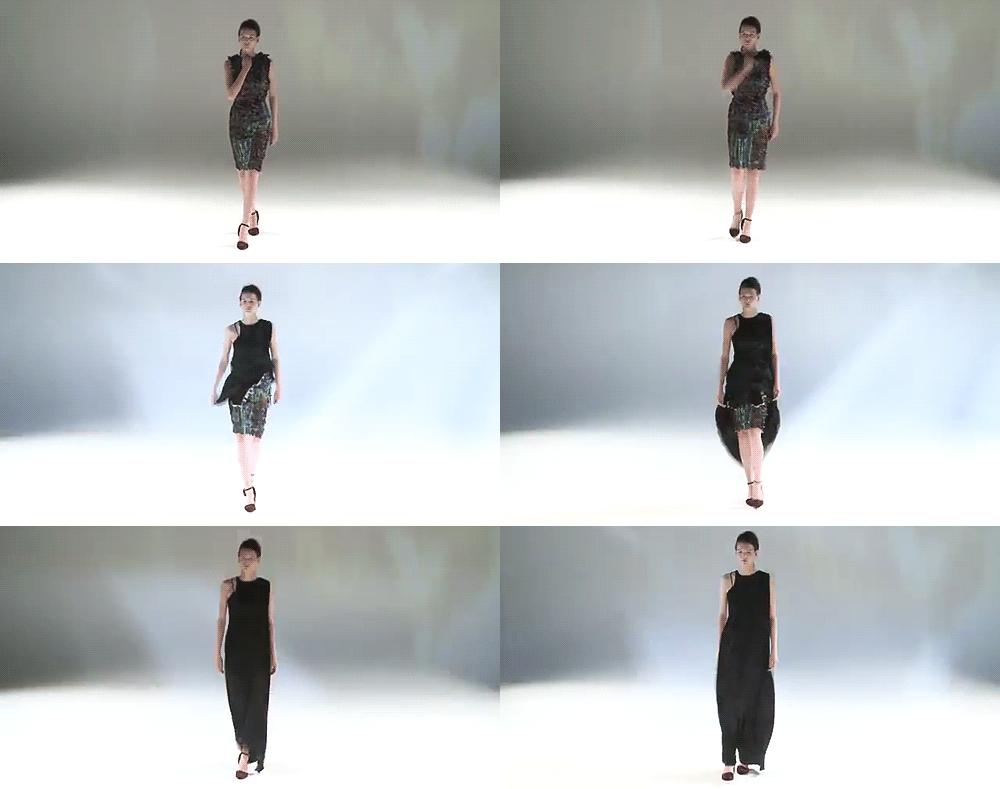
Chalayan!