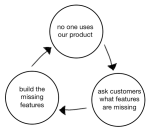


The “Product Death Cycle” diagram
1) No one uses our product
The natural state of any new product is that no one’s using it 🙂 So that’s not a problem in itself. However, the way you react to this problem is what causes the Product Death Cycle.
2) Ask customers what features are missing
One of the big early mistakes is to be completely user-led rather than having a product vision. This manifests itself in asking users “What features are missing?”
Here are the problems with this approach:
• Users who love your product now may not represent the much larger market of non-users who’ve never experienced it. So the feedback you get might be skewed towards a niche group, and the features they suggest may not be mainstream
• User research is great for coming up with design problems, but you can’t expect users to come up with their own design solutions. That’s your job! They may be stuck in a certain paradigm and won’t have the tools/skills to come up with their own solutions. Faster horses and all that
• “What features are missing?” assumes that just adding more features will somehow fix the problem. But there are many, many other reasons why your product may not be working- maybe the pricing is wrong. Or it’s not being marketed well, the activation is broken, or the positioning sucks, etc.
…
Instead of asking for what’s missing, instead the solution is to ask- what is the root cause of users not using the product? Where’s the fundamental bottleneck? In a world where 80% of daily active users are lost within 30 days, there’s a lot of reasons why users are bouncing before they even get into the “deep engagement features” you’ve built out. Asking engaged users what features they want won’t help much- instead you’ll likely get a laundry list of disorganized features that will push you towards your competitors.
…
3) Build the missing features
The second jump in the Product Death Cycle is to take features that customers have suggested, and just build the missing features. However, this quickly falls into the Next Feature Fallacy, which is the mistaken belief that just adding one more new feature will suddenly make people want to use your whole product.
…
Losing 80% of mobile users is normal. [Most] interaction with a product happens in the first few visits. That’s where you can ask the user to setup for long-term retention and to present the user with a magic moment. Building a bunch of “missing” features is unlikely to target the leakiest part of the user experience, which is in the onboarding. If the new features are meant to target the core experience, it’s important that they really improve the majority workflows within the UI, otherwise people won’t use them enough to change their engagement levels.
[How to fix?]
To break out of this part of the Product Death Cycle, ask yourself- is this enough of a change to influence the experience? Is it far enough “up the funnel” to impact the leakiest parts of the product experience? Is this just another cool feature that only a small % of users will experience?
The Product Death Cycle is tricky because it’s driven by the right intentions: Listen to customers and build what they want. People in the Product Death Cycle naturally believe that they are doing the right things, but good intentions don’t translate to good traction. Instead, ask “why?” over and over, to understand the root cause for lack of growth.
The response to these root causes should consist of a large toolkit of responses- maybe marketing: Pricing, positioning, distribution, PR, content marketing, etc. Maybe it has to do with the strategy: Going high-end instead of low-end. Building a utilitarian product instead of a network-based one, or vice versa. The point is, the solution should be tailored to the root cause, rather than to be explicitly driven by the desire of every product team to build more product.
– @andrewchen X @davidjbland’s Product Death Cycle diagram)
// there are corollary diagrams related to ‘traditional’ advertising and marketing, just waiting to be napkin-drawn with a skinny black marker…
while ‘physical product death’ has an incredibly long tail in secondary markets (eBay, garage sales, flea markets), retro fandom, collectors and museums.
 Wandering Wandering Star