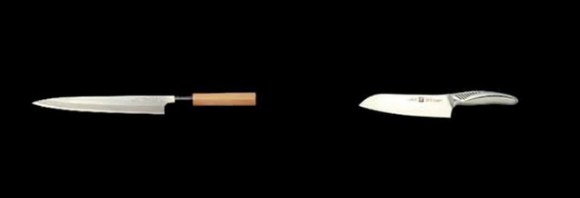
At the end of his talk he does a product comparison between the MUJI product and the non-MUJI product. It is similar to the advertisements that compare a particular brand to a conventional product, except that the comparison is not highlighting shortcomings in the one that have been resolved in the other, but is presenting the sales proposition as a difference in concept.
The non-MUJI product is a kitchen knife chosen to illustrate simplicity western style. Western style simplicity is to be understood as enabling a user with no particular skill to use it. The knife’s handle is shaped to be held in a specific way for effective cutting and to prevent the person using it from harm. On the contrary, Japanese style simplicity, or ‘emptiness’ is about allowing for the complexity of users of different skill to use and grow with the product. A MUJI grip-less knife is presented. Kenya Hara: “The grip-less knife seems to lack common courtesy at first sight. But it is within this universality that the user can hold it from any angle that we find emptiness”
Kenya Hara describes the MUJI knife’s particular traits as a culturally determined understanding of usability. He is implicitly explaining the brand that is MUJI. MUJI is not simple: it is empty.
Kenya Hara illustrates in his cerebral way that a brand is a certain vision of customer interaction with the company or its products. Brands are helped by a hint of philosophical insight. They require an understanding of what kind of a relationship is desirable to cultivate and maintain with the people who are concerned. Underlying such a relationship is not just keen business sense but also a conviction to inspire people and enable them to identify with a product, service or organisation.
 Wandering Wandering Star