



FIELD DRESSING SRULI RECHT A/W 2012 Where the darkness divides
STORY – This is the third complete menswear line from Sruli Recht. “This collection was lost out on the hunt, chasing the goal to no end.” The collection in three words – tailored, pulsing, visceral.
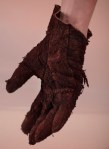
The latest menswear collection by fashion designer Sruli Recht of Iceland features leather made from dolphin skin, fabric woven from horse hair and silk extracted from a spider’s gland implanted in a goat. Most of the garments are made from one pattern piece and cut from a single piece of fabric. Accessories include glass slippers, a tinted plastic visor and a white saddle, plus a sniper rifle and knife carved in maple, sun-bleached and rubbed with horse hide. Boots are made of the calloused skin over the spines of horses.
MATERIALS
This season employs a global selection of wool, waxed cottons, leathers and silks, glass, timber and steel, complimented by Icelandic reindeer and horse skin. All the buttons are made from metal alloy rods, designed, moulded and drop-cast in the studio, and blackened.
Horsetail-hair Satin
Ásthildur Magnúsdóttir, a woman of iron will and a brain in each finger, wove 3cm a day in the dead darkness of an epic Icelandic winter. Made from the waste products of the horse farms and slaughterhouses, Ásthildur developed for us a hand-loomed satin from single strands of horsetail hairs
Cetacea Leather
And in those nets and on those beaches, leaving the water, the cold air it breaches.
Made by the man in the north, from bodies washed ashore, the Atlantic White-Sided Dolphin skin is nearly un-tannable, as the skin has structure more like an eye.
Spider-Silk Knit
We held down a spider, strapped its legs to a board, and reeled out its silk, for our silk spun hoard. Our knit originates from the silk gland of a spider, carefully placed in the milk duct of a goat. The single filament is reeled out of the goat millimetres at a time to produce the most difficult to obtain fibre in the world. Having secured 2 skeins of the silk, each many thousands of metres long, we spent 4 days unravelling it to prepare for knitting. A further week was spent gently coaxing two filaments into the knotted web of these garments… And then another week convincing it to become the emperor’s new clothing. Weight for weight, silk is stronger than steel and tougher than Kevlar.
Icelandic Wool
With a local knitting house, we designed two new knits for this season:
A Felt – Felted 100% Icelandic wool from a structured waffle knit base.
And a Knit – Knitted and brushed 50% Icelandic wool and 50% cotton knit in a tight tuck stitch.
The wool of The Icelandic sheep – Íslenska sauðkindin [a patched history]
Pure descendants of the same stock as the Norwegian Spelsau, brought to Iceland by the Vikings prior to 900 Anno Domine, Icelandic sheep have been bred unmixed for one thousand, one hundred years in a bitter, harsh environment. The baron moss-fields of Iceland yield rare game and consequently they are efficient herbivores.
Icelandic skins come in many colours and generally are not dyed. The hide is quite soft and are on average 6 square feet (0.56 m2) to 8 square feet (0.74 m2) in size. Often left unshorn for the winter, the wool length can be up to 8 inches (200 mm) in length.
Icelandic fleece is dual-coated, and this wool is made up of two types of fibres: coarse and fine. The long outer coat is called Tog and the fine inner coat called Thel. Tog is generally classified as a medium wool around 27 micrometres in diameter. This wool is good for weaving and for use in other durable products and it is long, glossy, tough, and water resistant.
Thel, being the finer wool and classified as such, is generally around 20 micrometres in diameter. This finer wool is used for garments that touch the skin as it tends to be softer and more insulating, providing a high resistance to cold and possessing a unique texture and natural colours.
 Wandering Wandering Star